Electric Hoists: The Invisible Heroes of Industrial Backbone
In the grand panorama of modern industry, we are often awestruck by intelligent robots, giant gantry cranes, and automated production lines. However, beneath these behemoths lies a device that, though unassuming in appearance, is ubiquitous. With its silent yet steadfast power, it has become the "invisible hero" supporting the entire modern industrial logistics system—the electric hoist.
As a small, lightweight lifting device driven by electricity, using drums or sprockets to lift, lower, and horizontally move heavy objects, the electric hoist has long permeated every capillary of industrial production. From bustling ports to precision manufacturing workshops, from massive warehousing and logistics to routine automobile repair, its presence is ubiquitous, silently improving the operational efficiency of society with its high efficiency, precision, and reliability.
I. Core Structure and Working Principle: Simple Yet Complex
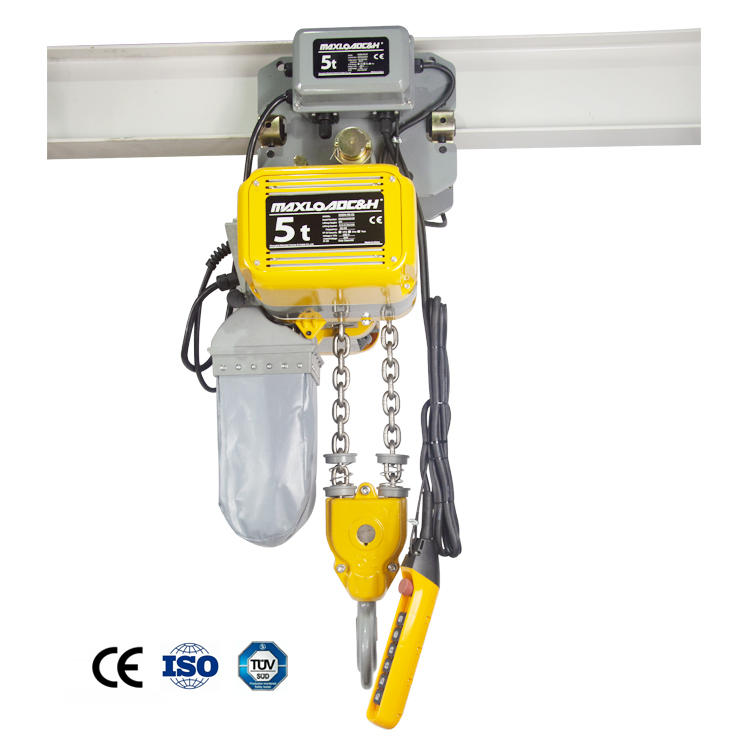
The design of the electric hoist is a prime example of "simple yet complex" engineering. Its core components work together to accomplish complex lifting tasks.
Power Core—Motor: The motor is the heart of the electric hoist. Typically, electric hoists employ compact, high-torque conical rotor motors or disc motors. When energized, the rotor generates not only rotational torque but also axial magnetic pull, causing axial movement and thus tightening or loosening the brake rings. This "mechatronics" braking design allows the motor to brake immediately upon power failure, ensuring the load can be safely suspended in any position—a safety advantage unmatched by manual hoists.
Transmission Core—Reduction Mechanism: The high-speed, low-torque output of the motor is not directly suitable for lifting. Therefore, a precise and efficient reduction mechanism is crucial. It typically consists of multi-stage gears, which, through progressive gear transmission, convert the high-speed rotation of the motor into a low-speed, high-torque output from the drum or sprocket. The manufacturing precision of this mechanism directly determines the electric hoist's noise level, transmission efficiency, and service life.
Bearing Core—Drum, Wire Rope/Lifting Chain: This is the part that directly contacts the load. Wire rope hoists use high-strength wire rope wound on the drum, offering high load-bearing capacity and are suitable for applications with high lifting heights and heavy workloads. Chain hoists, on the other hand, utilize high-strength alloy chains that have undergone special heat treatment, resulting in a more compact structure and lighter weight. They are suitable for workstations with limited space or requiring precise alignment.
Control Nerves – Electrical System: Operators can issue commands to the electric hoist via a control handle or remote control that integrates up/down and left/right (if equipped with a trolley) directions. The advanced electrical system integrates overheat protection, phase loss protection, limit switches, and other safety devices, forming a reliable safety protection network.
II. Ubiquitous Applications: The "Muscles" and "Skillful Hands" of Industrial Civilization
The value of electric hoists is most fully realized in their widespread applications.
On the "Skeleton" of Manufacturing: Alongside machining and assembly lines, electric hoists are installed on I-beam rails, becoming flexible bridge or cantilever cranes. They easily lift heavy parts and mold assemblies, precisely delivering them to the next workstation, greatly reducing the labor intensity of workers and increasing production speed.
In the "blood vessels" of logistics, in large warehousing and distribution centers, electric hoists are indispensable assistants to automated racking systems. They are responsible for lifting tons of goods to storage locations several stories high, or removing them from the racks, maximizing space utilization and automating goods storage and retrieval, making them an essential part of modern smart logistics.
At the "backbone" of construction: In factory construction and equipment installation sites, electric hoists are often the core of winches or simple lifting equipment. Whether installing large fans or water pumps, or lifting steel structural beams, they ensure the safety and progress of the project with stable output.
At the "operating table" of maintenance: In auto repair shops, an electric hoist fixed to a bracket can easily "detach" the engine assembly from the vehicle body, facilitating maintenance work. Its smooth operation avoids secondary damage to precision components during lifting.
III. Safety: The Eternal Cornerstone and Bottom Line
Despite continuous technological advancements, "safety" remains the unshakable cornerstone of the design, manufacture, and use of electric hoists. Every qualified electric hoist is equipped with a multi-layered safety system: Overload protection: When the load exceeds the rated weight, the lifting circuit is automatically cut off to prevent structural damage or falls caused by insufficient power.
Dual braking system: In addition to the normally closed brake built into the motor, many hoists are also equipped with mechanical or electromagnetic auxiliary safety brakes, forming a double safety net.
Upper and lower limit switches: Automatically limit the highest and lowest positions of the hook to prevent over-crashing or excessive lowering that could cause wire rope tangling.
Emergency protection: Such as phase loss protection and undervoltage protection, ensuring safe shutdown of the equipment in the event of power abnormalities.
However, even the most comprehensive safety devices cannot function without proper human operation. Regular maintenance, pre-operation safety checks, and professional training for operators are just as important as the safety performance of the equipment itself.

Conclusion: The electric hoist, this seemingly ordinary industrial equipment, actually carries immense power, maintains production safety, and drives an efficiency revolution. It may lack a flashy appearance, but with its resilience, reliability, and precision, it silently contributes to every corner where strength is needed. It is an indispensable muscle and nerve in the backbone of industry, a true and respectable "invisible hero" in the process of modernization. When we gaze at this vast industrial world, let us not forget that it is the coordinated operation of these countless "invisible heroes" that has jointly supported our glorious modern civilization.
 0086 156 1824 5535
 0086 156 1824 5535
 kimliu@chnhoist.com