Flexible Lifting: The Smart Choice – Electric Hoists and Jib Cranes
In the grand tapestry of modern industrial production, material handling acts as the silent bloodstream, maintaining the continuity and efficiency of production processes. Among these, electric hoists and jib cranes, two classic and widely used lifting devices, play an indispensable role in various production scenarios thanks to their unique structural characteristics and flexible operational capabilities. They are not merely simple lifting tools, but crucial solutions for optimizing space utilization, improving operational precision, and ensuring operational safety in modern production systems.
I. Electric Hoists: Precise Control of Vertical Space
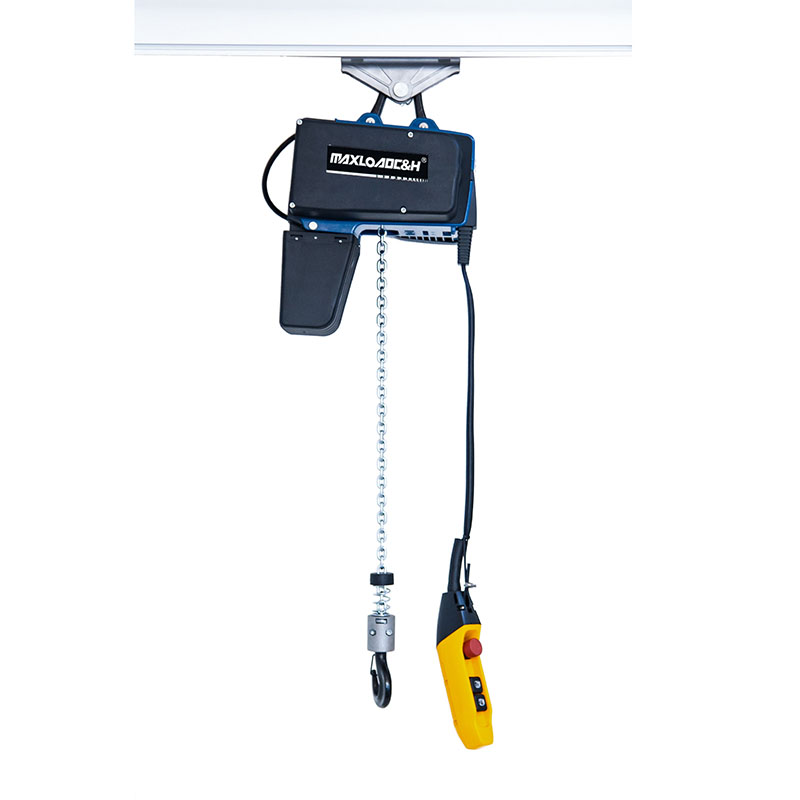
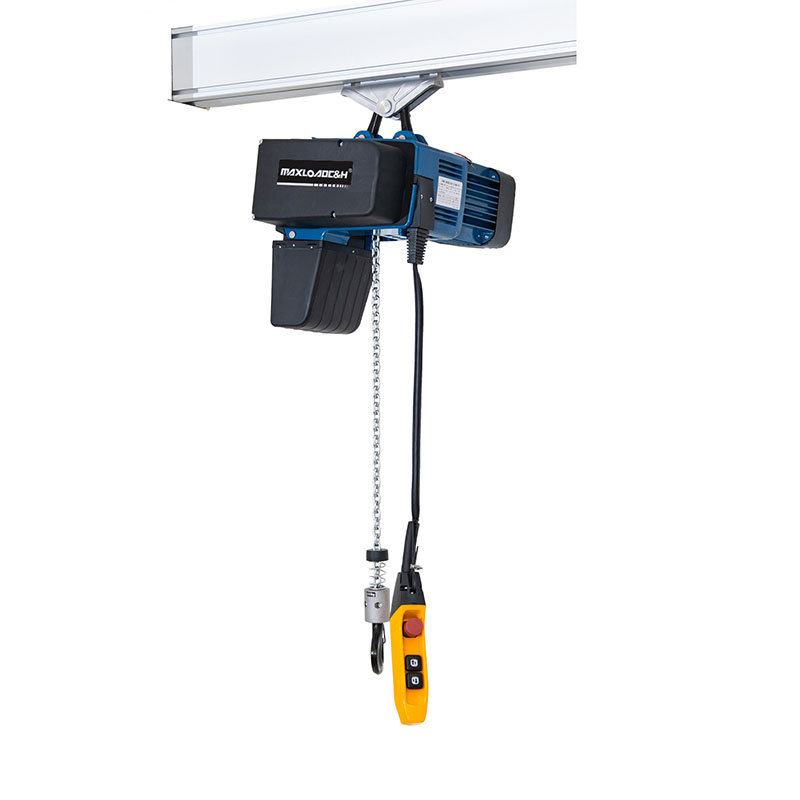
An electric hoist is a compact and easy-to-operate light-duty lifting device, typically composed of a motor, reduction gear mechanism, drum or sprocket, and hook. Its working principle is based on motor drive, which converts high-speed rotation into low-speed, high-torque motion suitable for lifting heavy objects through a precision reduction gear mechanism, ultimately achieving vertical lifting and horizontal movement of the load.
Based on their structural form, electric hoists can be mainly divided into two categories: wire rope electric hoists and chain electric hoists. The former uses steel wire rope as the load-bearing medium, characterized by a large lifting height, relatively light weight, and smooth operation. The latter uses high-strength alloy chains with a more compact structure, making it especially suitable for confined spaces or applications requiring direct pull installation. In addition, depending on the operating environment, there are standard models for general factories, as well as special hoists designed for explosion-proof, corrosion-resistant, high-temperature, and other special working conditions.
The advantages of electric hoists are significant. First, they have extremely high lifting efficiency and good speed control performance, enabling precise load positioning. Second, their modular design makes installation and maintenance relatively simple. Most importantly, they occupy minimal space, making full use of the upper space of the factory building and hardly interfering with the ground work area. Therefore, they are widely used in warehouse cargo handling, production line component assembly, equipment maintenance in repair workshops, and any occasion requiring frequent vertical lifting operations. Key technical parameters include rated lifting capacity, lifting height, lifting speed, working class, motor power, and protection class.
II. Jib Cranes: Flexible Arms in Fixed Areas
As the name suggests, a jib crane is a lifting device with a cantilevered arm. Its core structure typically consists of a column, a cantilever beam, and a lifting and rotating mechanism installed on the cantilever. It creates a cylindrical working space with the column as the center and the cantilever length as the radius.
Jib cranes are mainly divided into column-mounted jib cranes, wall-mounted jib cranes, and wall-bracket jib cranes. Column-mounted cranes are independently installed and have a wide coverage area; wall-mounted cranes rely on wall columns, saving floor space; and wall-bracket cranes are directly fixed to a sturdy wall, suitable for operations along the wall. Its unique structure gives it irreplaceable advantages: providing excellent local coverage, allowing operators to easily deliver loads to any point within the working area through manual pulling, electric rotation, or a combination of both, achieving a highly efficient "material-to-person" operation mode, greatly reducing worker movement and physical exertion.
Jib cranes are ideal for material handling at fixed workstations in workshops, production lines, and dock loading and unloading points. For example, in a machining workshop, it can efficiently deliver raw materials to multiple machine tools in rotation and remove finished products; at an assembly station, it can accurately deliver parts to assembly workers; in smaller warehouses or logistics transfer areas, it can effectively supplement areas that large overhead cranes cannot cover. When choosing a jib crane, key considerations include the maximum lifting capacity, cantilever length, rotation angle, lifting height, and the installation method and load-bearing requirements of the column.
III. Collaboration and Selection: Matching the Best Solution to the Application Scenario
Although electric hoists often appear as the "actuating terminal" of jib cranes, the two are more often independent devices selected or combined based on core needs.
The core capability of an electric hoist lies in efficient vertical lifting. When the operation requires primarily vertical lifting, and the horizontal movement distance is short, or the trajectory is fixed, using an electric hoist alone is often the most economical and direct solution. Its advantages lie in its simple system, relatively low investment cost, and convenient maintenance.
The core capability of a jib crane lies in flexible local area coverage. When working in a relatively fixed work area requiring high-frequency, multi-point material handling, the advantages of a jib crane become apparent. It deeply integrates lifting and horizontal movement functions, offering intuitive operation and significantly reducing auxiliary work time, thereby improving workstation efficiency. This is especially suitable for precise delivery in "the last mile" of production lines and around equipment clusters.
Therefore, when making a selection, a systematic needs analysis should be conducted:
1. Working range: Clearly define the required vertical height and horizontal area to be covered. Is it point-to-point lifting, or coverage of a planar area?
2. Usage frequency and efficiency requirements: For high-frequency, fast-response workstation operations, the efficiency gains of a jib crane may far outweigh its initial investment.
3. Space limitations: Evaluate the load-bearing capacity of columns and walls at the installation site, as well as the availability of ground and overhead space. Wall-mounted jib cranes can significantly save floor space.
4. Load characteristics: Confirm the maximum lifting capacity, the shape and size of the load, and whether special lifting equipment is required.
5. Process flow: The equipment needs to seamlessly integrate into the existing process. Is it an independent operation or does it need to be linked with other transfer systems?
Conclusion
Electric hoists and jib cranes, one focusing on powerful lifting in the vertical dimension, and the other excelling in agile movement in the horizontal area, together interpret the philosophy of "effortless, precise, and efficient" material handling with different mechanical principles. In today's modern manufacturing industry pursuing lean production and flexible manufacturing, a deep understanding of the technical characteristics and applicable boundaries of these two types of equipment, and their scientific selection and rational application based on specific production scenarios, spatial layout, and process requirements, is not only key to improving the efficiency of individual work steps, but also an important part of optimizing the overall logistics system and empowering intelligent manufacturing. They will continue to serve as reliable industrial partners, demonstrating the wisdom of effortless lifting within workshops and factories.
 0086 156 1824 5535
 0086 156 1824 5535
 kimliu@chnhoist.com