Electric Hoists: Key Equipment for Lifting in Modern Industry
Lifting equipment plays an indispensable role in modern industrial production, warehousing and logistics, and construction. As an important member of the lifting equipment family, electric hoists, with their compact structure, ease of operation, and high efficiency, have become the preferred equipment for lifting and handling operations in many industries. From workshop production lines to large warehouses, from construction sites to port terminals, electric hoists are ubiquitous, silently supporting the efficient operation of modern industry.
I. Performance Characteristics of Electric Hoists Selecting a suitable electric hoist requires considering several technical parameters, the most important of which are rated lifting capacity, lifting height, lifting speed, and working class.
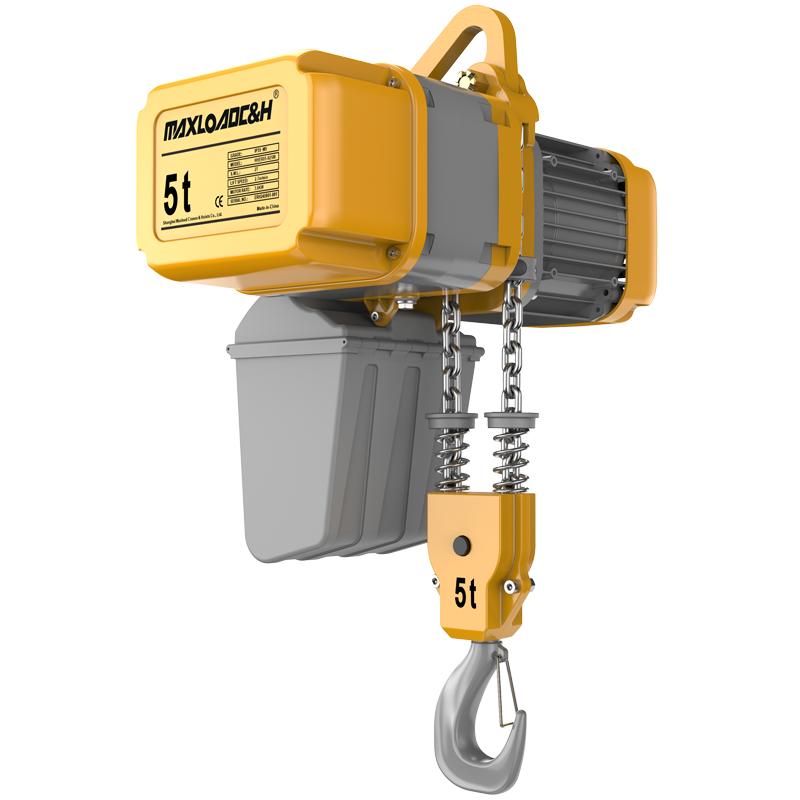
Rated lifting capacity is the most basic technical parameter of an electric hoist, indicating the maximum weight that the equipment is allowed to lift under normal operating conditions. Users need to select according to their actual needs, leaving a certain safety margin.
Lifting height refers to the vertical distance between the lowest and highest working positions of the hook. This parameter determines the working range of the electric hoist. Special needs can be met by increasing the length of the wire rope or chain to achieve higher lifting.
Lifting speed directly affects work efficiency and is usually related to the lifting capacity—the larger the lifting capacity, the slower the lifting speed. Modern electric hoists mostly use dual-speed or frequency conversion control, allowing adjustment of the lifting speed as needed to balance efficiency and accuracy requirements.
The working class reflects the intensity of use of the electric hoist, determined by the total working time and load rate. Different working classes correspond to different design lifespans and usage frequencies; correctly selecting the working class ensures long-term stable operation of the equipment.
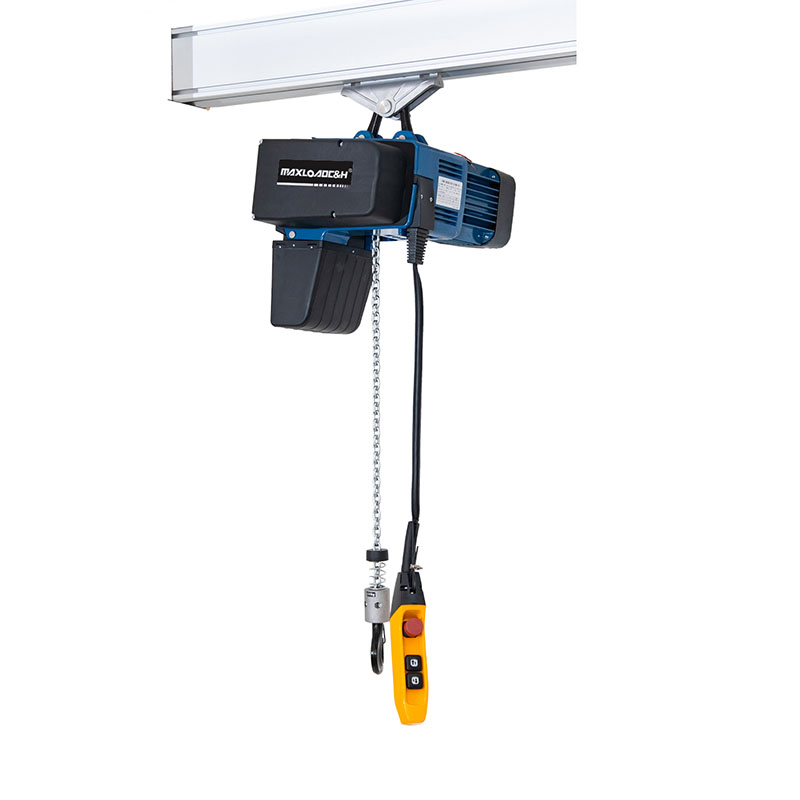
The advantages of electric hoists are not only reflected in their technical parameters but also in their excellent performance characteristics: compact structure, light weight, and small footprint; simple operation, usually requiring only control buttons to complete all actions; convenient maintenance, with modular design making troubleshooting and parts replacement easier; high safety, equipped with multiple protection devices such as overload protection, limit switches, and emergency braking systems.
II. Applications in Various Industries
Manufacturing and Assembly Workshops
In manufacturing, electric hoists are widely used in various stages of the production line. Automobile manufacturers use electric hoists to lift large components such as engines and transmissions; machining workshops utilize them to move heavy workpieces onto machine tools; on assembly lines, electric hoists assist workers in precisely positioning parts, improving assembly accuracy and efficiency. Their flexibility and precise control capabilities make electric hoists an indispensable part of modern intelligent manufacturing systems.
Warehousing and Logistics: Modern warehousing and logistics demand extremely high space utilization, where electric hoists excel. In automated warehouses, electric hoists work in conjunction with racking systems to achieve vertical transport of goods; in distribution centers, they assist in loading and unloading heavy goods; in cold chain warehouses, specially designed electric hoists can operate stably in low-temperature environments. With the rapid development of e-commerce logistics, the application of electric hoists in automated sorting systems is becoming increasingly widespread.
Construction and Installation: Construction sites are another major application area for electric hoists. During construction, electric hoists are used to lift building materials such as steel bars, formwork, and prefabricated components; during interior decoration, they assist in installing large equipment such as air conditioning units and water tanks; in steel structure installation, the precise control capabilities of electric hoists are particularly important. Compared to large cranes, electric hoists offer significant advantages in indoor and confined space operations.
Energy and Infrastructure
In the power industry, electric hoists are used for equipment installation and maintenance in hydropower stations, thermal power plants, and nuclear power plants; in wind power, they assist in the installation and maintenance of wind turbine components; in the petrochemical industry, electric hoists are used in the installation of large equipment such as reactors and storage tanks. These applications typically have extremely high requirements for equipment safety and reliability, and electric hoists have earned the industry's trust thanks to their mature technology and multiple protection measures.
Special Environment Applications
In addition to conventional applications, electric hoists have been developed into various special models to adapt to extreme environments. Explosion-proof electric hoists utilize special designs and materials, making them suitable for flammable and explosive locations; low-headroom electric hoists are specifically designed for height-confined spaces, maximizing the use of vertical space.
III. Safe Operation and Maintenance
As special equipment, the safe operation of electric hoists is paramount. Operators must undergo professional training and be familiar with the equipment's performance and control methods. Before the operation, the equipment condition should be checked to ensure that the lifting gear is intact, the limit switches are effective, and the brakes are reliable. During hoisting, overloading, oblique pulling, or sudden changes in direction are strictly prohibited, and no one should stand under the heavy load. When not in use for extended periods, the hook should be raised to its maximum position and the power supply disconnected.
Daily maintenance is crucial for ensuring the long-term stable operation of the electric hoist. A basic inspection should be performed before each use, including the condition of the wire rope or chain, braking performance, and control button sensitivity. Regular maintenance should be performed according to the manufacturer's recommendations, generally including cleaning the equipment, checking fasteners, replenishing lubricant, and testing safety devices. For critical components such as the wire rope, hook, and brake, a replacement record should be maintained to ensure timely replacement of parts that have reached the end of their service life.
Common malfunctions include electrical system problems, mechanical component wear, and control system failure. Most malfunctions can be avoided through regular maintenance, but when a malfunction occurs, it should be repaired by professional technicians. Unauthorized disassembly and repair by non-professionals are strictly prohibited.
IV. Development Trends of Electric Hoists
Electric hoists are undergoing profound technological changes. Intelligentization is currently the most important development direction. Modern electric hoists are increasingly equipped with sensors and control systems to monitor load, speed, and equipment status in real time, predict maintenance needs through data analysis, and reduce unexpected downtime. Lightweighting and energy efficiency are other important trends. The application of new materials, such as high-strength aluminum alloys and composite materials, allows electric hoists to significantly reduce their weight while maintaining strength; high-efficiency motors and optimized transmission systems reduce energy consumption, meeting the requirements of green manufacturing.
Human-centered design is also receiving increasing attention. Ergonomic controllers, low-noise designs, and intuitive status displays improve the operator's experience; modular designs simplify installation and maintenance, reducing the overall cost over the equipment's lifecycle.
In the future, with the further development of artificial intelligence and automation technologies, electric hoists will become more intelligent and autonomous, capable of collaborating with other equipment to complete complex lifting tasks without human intervention, supporting fully automated smart factories.
Conclusion: From simple manual lifting to mechanical drive, and now to intelligent equipment, the development of electric hoists reflects the progress of industrial technology. As a key piece of equipment in modern material handling, electric hoists not only improve operational efficiency and reduce labor intensity but also ensure the safety and precision of industrial production.
With technological advancements and evolving application needs, electric hoists will continue to develop towards intelligence, efficiency, and specialization, playing a vital role in more fields. For users, understanding the technical characteristics of electric hoists and correctly selecting, operating, and maintaining the equipment will maximize its value and lay a solid foundation for safe production and efficiency improvement. In the wave of industrial automation and intelligent manufacturing, this classic piece of equipment is showing renewed vitality and continues to support the vigorous development of modern industry.
 0086 156 1824 5535
 0086 156 1824 5535
 kimliu@chnhoist.com