The Art of Collaborative Material Handling with Electric Hoists and JIB Cranes
In modern production workshops, warehouses, or assembly lines, the precise and efficient flow of materials is crucial for ensuring production rhythm and improving overall operational efficiency. Faced with complex and diverse handling needs—such as the fixed-point assembly of heavy components, material supply for flexible production lines, or precision lifting within confined spaces—single handling equipment often falls short. At this point, combining the vertical lifting advantages of electric hoists with the horizontal coverage and flexible rotation capabilities of jib cranes to build a collaborative material handling system is becoming an excellent solution to the challenges of short-to-medium distance, high-frequency, and precisely positioned material handling.
I. Core Component Analysis: Each has its own function, complementing each other's strengths
JIB Crane: The Flexible Space Coverer
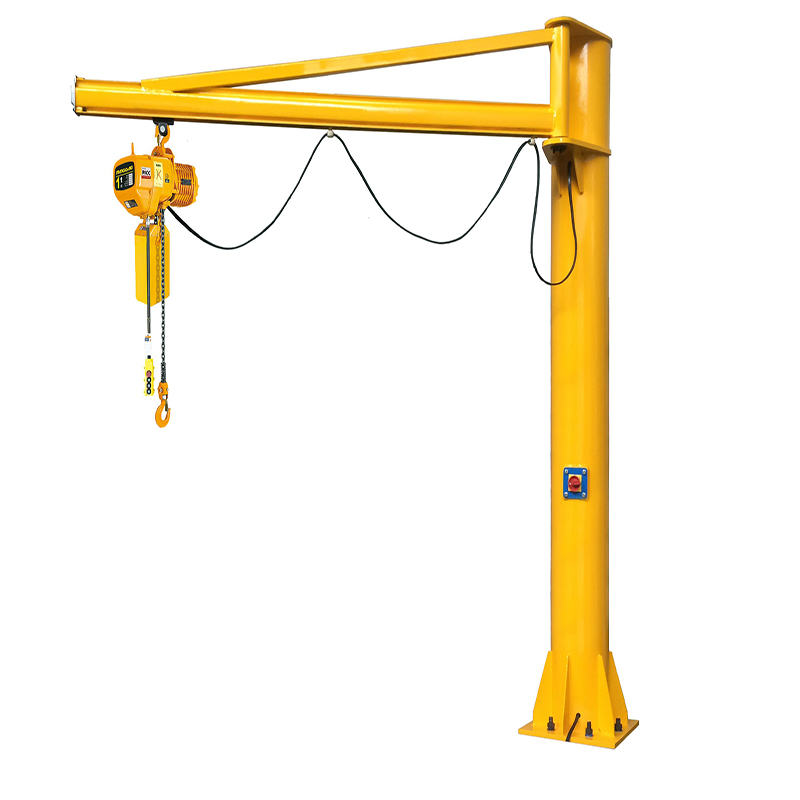
The core feature of a jib crane lies in its cantilever structure, typically composed of a column, a rotating mechanism, and a cantilever beam. It can achieve material coverage within a circular or fan-shaped area centered on the column. Its core advantages are:
Horizontal Flexibility: The cantilever can rotate horizontally by ≥180 degrees, directly and quickly "delivering" materials to the target workstation, eliminating the space and time required for straight tracks or vehicle turns.
Precise Positioning: Combined with a manual or electric rotation system, operators can easily fine-tune the load to a precise position, making it particularly suitable for machine tool loading and unloading, and parts transfer between workstations.
Space Saving: Column-mounted installation greatly saves floor space, especially suitable for installation along walls or column grids, making full use of the workshop's vertical space without affecting ground traffic.
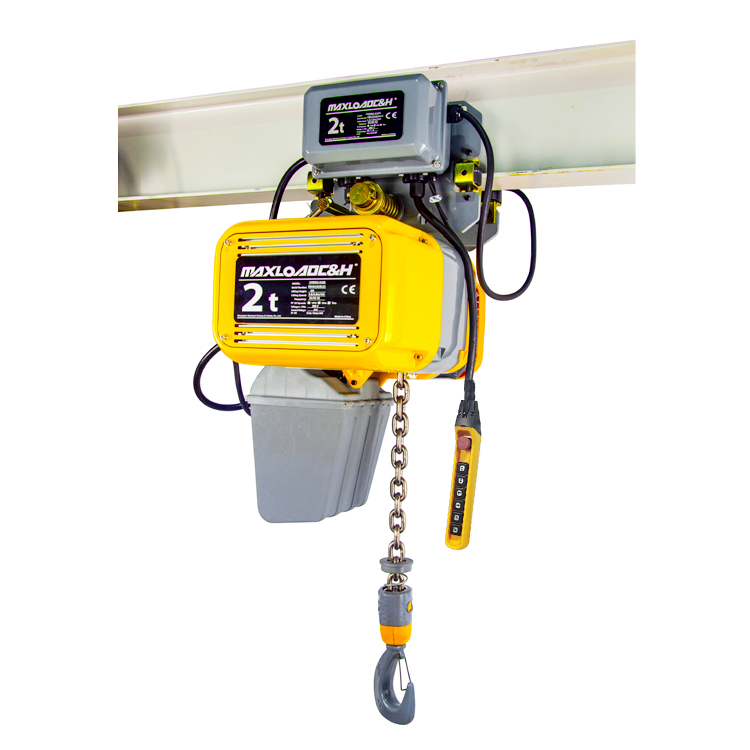
Electric Hoist: A Reliable Vertical Power Source. The electric hoist is the core component providing vertical lifting power, typically mounted on the traveling trolley of the cantilever. Its main features include:
High-Efficiency Lifting: Driven by a motor, it achieves smooth and rapid lifting of heavy objects through gears or worm gear mechanisms, significantly reducing labor intensity.
Precise Control: Equipped with multiple speed settings and a jog mode, it allows for millimeter-level micro-lifting and lowering of heavy objects, meeting the requirements of precision assembly or alignment.
Safe and Reliable: Standard features include overload protection, limit switches, and emergency braking to ensure safe and controllable lifting operations.
When combined, the two systems achieve a perfect division of labor: the cantilever handles the horizontal delivery range, while the hoist handles the vertical lifting and lowering operations, enabling seamless three-dimensional material handling from start to finish.
II. Collaborative Workflow: Simplified, Smooth, and Efficient
A typical electric hoist-cantilever collaborative handling process fully embodies the efficiency improvement of "1+1>2":
Covering and Grabbing: Operators easily move the cantilever via control devices, precisely positioning the electric hoist suspended below directly above the material to be transported. The hoist lowers its hook or specialized lifting tool to safely grab the material.
Lifting and Rotation: The electric hoist lifts the material to a safe height. Then, the cantilever smoothly rotates, traversing equipment, workbenches, or other obstacles to directly transport the material to the target location.
Precise Positioning and Placement: Through the micro-motion rotation of the cantilever and the precise jogging descent of the electric hoist, materials are placed precisely at the designated location. The entire process can be easily completed by a single person on the ground, without the need for other vehicles or multiple personnel.
Reset and Standby: After placement, the unloaded hoist can be raised to a height that does not obstruct operations below, and the cantilever can be rotated to a frequently used picking point, awaiting the next handling instruction.
This collaborative mode completely changes the traditional complex process of "forklift picking → transportation → positioning → unloading," compressing multiple steps into a continuous "direct aerial" action.
III. In-depth Analysis of Collaborative Advantages: A Win-Win Situation for Efficiency, Safety, and Economy
Significantly Increased Production Efficiency:
Shorter Handling Time: The point-to-point "direct aerial" path is the shortest path, avoiding detours and waiting times associated with ground transportation.
Reduced Operational Steps: Integrating picking, transportation, and placement into a single system ensures seamless and continuous operation, making it particularly suitable for production lines with tight schedules.
Optimized Ergonomics: Precise operator positioning and reduced effort minimize unnecessary movement, reducing fatigue and allowing for greater focus on precise alignment and safety.
Significantly Optimized Space Utilization: Fully utilizes overhead space, virtually eliminating the need for valuable ground-level passageways, freeing up space for other equipment, material storage, or safe areas.
Especially suitable for renovating older factories with limited space, or adding workstations to existing production lines without disrupting the overall layout.
Comprehensively Improved Operational Safety and Precision: The smooth lifting and controlled movement of the electric hoist prevent material swaying, protecting precision parts and machined surfaces.
Precise 3D positioning capabilities directly improve the quality and consistency of assembly and loading.
Economical Investment and Operating Costs: Reasonable Initial Investment: Compared to laying full-area overhead crane tracks or deploying multiple large handling vehicles, this collaborative system is often more cost-effective.
Low Operating Costs: Low energy consumption due to electric drive, relatively simple maintenance, and single-person operation significantly reduces labor costs.
High flexibility and adaptability: The system can be repositioned or expanded according to process changes, protecting long-term investments.
IV. Application Scenarios and System Selection Considerations
This collaborative solution is widely used in:
Machinery: Frequent loading and unloading of materials for lathes, milling machines, and machining centers.
Assembly lines: Transferring large components such as engines and gearboxes between workstations.
Warehousing and logistics: Transferring goods between shelving areas and packaging/inspection areas.
Maintenance workshops: Disassembling and installing heavy components during equipment maintenance.
Laboratories or cleanrooms: Moving precision instruments or special materials.
When planning and selecting the system, the following should be considered:
Load analysis: Determine the maximum lifting capacity, common load, and center of gravity position.
Coverage range: Determine the cantilever length, rotation angle, and column installation position based on the workstation layout.
Accuracy and speed requirements: Select the appropriate level of hoist lifting speed and cantilever rotation control method.
Environmental adaptability: Consider special environmental requirements such as dustproof, waterproof, explosion-proof, or low-temperature environments.
Human-Machine Interaction and Safety: Select appropriate control methods and ensure the installation of complete safety devices.
Conclusion: The collaboration between electric hoists and jib cranes is not simply a combination of equipment, but a spatial reorganization and process reengineering based on material flow logic. It breaks down rigid assembly lines into flexible, precise "aerial transport units," achieving a qualitative leap in material handling from "transportation" to "precise delivery." In today's era of deepening intelligent manufacturing and lean production, this efficient, flexible, and economical collaborative transport solution is increasingly becoming a core tool for improving internal workshop logistics and empowering enterprises to reduce costs and increase efficiency. Through scientific planning and reasonable selection, it will undoubtedly bring a substantial leap in enterprise productivity.
 0086 156 1824 5535
 0086 156 1824 5535
 kimliu@chnhoist.com