Workshop Environment Determines the Success or Failure of Equipment
Many factories, when purchasing electric hoists, instinctively focus on "how much weight can it lift" and "how high can it go"—which is certainly not wrong. But often, after the equipment arrives and is installed, problems emerge within a month: the remote control signal is jammed and unresponsive, the motor overheats and trips protection frequently, or the hook in an acid-washing shop rusts as if it had been salvaged from the sea.
Where does the problem lie? It lies in the fact that during selection, people stare only at the specification sheet and forget to look up at the "environment" in which the equipment will work.
An electric hoist is not a standard off-the-shelf component; it is a lifting device that must be integrated into a specific workstation, adapted to a specific space, and designed to withstand specific operating conditions. Below, we break down the workshop environment to see which factors truly affect selection and how to evaluate each step.
I. Spatial Dimensions: It's Not Enough That It "Fits"
The primary constraint of any workstation is always space.
Many workshops have a clear height of only just over 4 meters, but the purchase order specifies a "lifting height of 6 meters"—such orders are clearly copied from another site's specifications. The lifting height of an electric hoist is the distance from the hook's upper limit to its lower limit. If the workshop's clear height is insufficient, even after installation, the hook either cannot reach the floor or hits the rail at the top of its travel, creating a safety hazard.
The correct approach is to measure three actual values: the rail installation height, the hook's upper-limit position, and the maximum required ground clearance for lifting workpieces. The effective lifting height is calculated as:
Rail bottom height – Upper-limit distance – Sling/rigging height – Safety margin
If the calculated result is insufficient, you must either lower the lifting point, choose a low-headroom hoist, or accept a two-tier rail system—but the latter doubles the cost.
Now consider horizontal space. Equipment, pillars, and piping on both sides of the workstation determine the hoist's travel width and the hook's lateral approach capability. Some hoist models are relatively wide and may experience wheel-flange interference with the rail on small-span I-beams, requiring rework on the track after installation. So the first thing to check in the product catalog is not the lifting capacity, but the rail adaptability range and minimum turning radius—if it is a curved track, this must be calculated in advance.
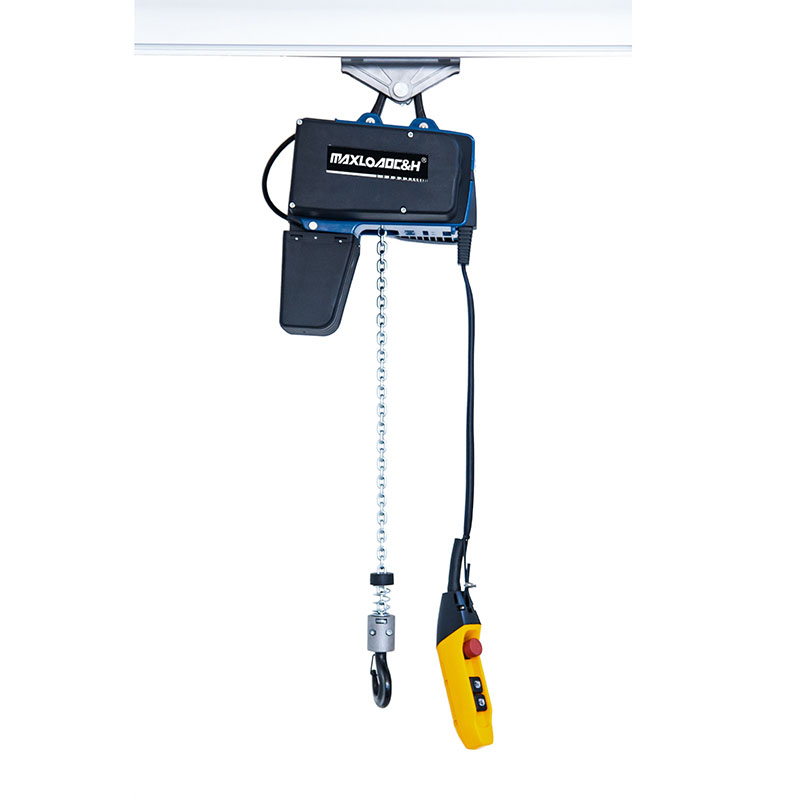
II. Floor Conditions and Operator Position: No One Wants to Operate a Swaying Hoist While Standing
The floor condition of the workstation directly affects the operating method and the operator's standing position.
If the workshop floor is hardened concrete and level, and the operator can stand in a safe zone to operate via a pendant cord or remote control, that is the most conventional scenario. However, if the floor is contaminated with oil or water, or if the workstation is adjacent to cleaning tanks or paint lines where the floor is slippery, then you must consider: where should the operator stand for the best visibility and the least risk of slipping? Is the remote control's transmission range sufficient to complete all actions from a safe distance? Is the pendant cord long enough to allow the operator to retreat to a safe zone?
A more subtle issue is the hook's "swing space." When the workstation is crowded with equipment, if the hoist lifts at too high a speed under load, the hook will swing horizontally and is liable to collide with surrounding equipment. In such cases, special attention must be paid during selection to whether the lifting speed is adjustable or whether a creeping speed is available. Many hoists advertise dual-speed lifting, but the slow speed is still too fast—the more confined the workstation, the more important the lower speed limit. This is not something you can read from a data sheet; you have to experience it on site.
III. Ventilation and Heat Dissipation: Whether the Motor Burns Out Depends on the Air
This is the most easily overlooked factor during selection.
Electric hoist motors operate on an intermittent duty cycle, with heat dissipation mainly relying on natural convection from the housing and forced air cooling from a fan. If the workstation is in an enclosed space, a ventilation shaft, a basement, or near heat sources, with ambient temperatures consistently exceeding 40°C, the motor's actual output capacity will drop noticeably—because the temperature rise margin is consumed.
In this case, you cannot select based on standard operating conditions; you must derate the capacity. For example, a standard 1-ton hoist operating continuously in a 50°C environment may have an actual safe working load of only 0.8 tons. If you do not inform the manufacturer of the ambient temperature during procurement, the equipment will trip overheating protection frequently upon arrival, and swapping for a larger hoist will waste money and delay the project.
Even more extreme are workstations with dust or fibrous particles. Suspended matter in textile mills, feed mills, and woodworking shops can clog the motor fan covers and brake cooling fins, leading to heat dissipation failure. In such cases, you should choose a totally enclosed motor, an IP55 or higher protection rating, models with dust-explosion-proof markings, and externally adjustable brakes for easy periodic cleaning.
IV. Cleanliness: Not All Workshops Allow Iron Filings
Semiconductor, pharmaceutical, food, and precision assembly workshops have strict cleanliness requirements for the air.
Ordinary electric hoist gearboxes "breathe"—as temperature changes, internal air expands and contracts, expelling oil mist and wear particles into the outside environment. In a clean workshop, these microscopic contaminants are enough to reduce product yield. In such cases, you need fully sealed gearboxes with breather filters, or directly choose stainless-steel-clad cleanroom-specific hoists with smooth surfaces and no dust-collecting dead corners.
There is also a difference between lifting chains and wire ropes: wire ropes release tiny amounts of lubricating oil mist and worn metal particles during use, whereas chains are relatively cleaner, but chain-wheel wear also generates particulates. For ISO Class 7 or cleaner environments, stainless steel chains with solid-film lubrication coatings are recommended, with replacement frequencies twice as high as in ordinary conditions.
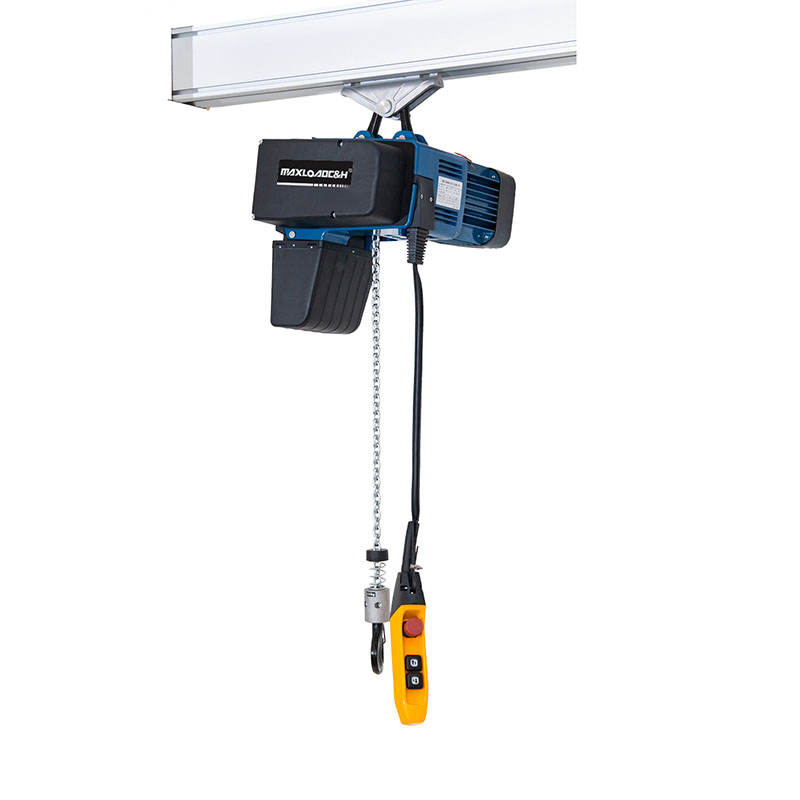
V. Explosion-Proof Requirements: It's Not Enough to "Have a Certificate"
Whether the workstation contains flammable gases, vapors, or dust is a legally mandatory item to confirm.
However, many purchasers only know that they need "explosion-proof" without distinguishing between explosion-proof grades. Common explosion-proof markings like Ex d IIB T4 and Ex de IIC T6 differ by more than one level of safety—the former is suitable for general chemical gases, while the latter is required for extremely explosive media such as hydrogen and acetylene. More critically, an explosion-proof hoist is not "safe just because you bought it"; its installation, wiring, flameproof gap maintenance, and periodic inspections are all strictly regulated. If the workstation itself has poor ventilation and high accumulation risk, the equipment alone is insufficient.
When selecting an explosion-proof hoist, you must also ask clearly: which parts are explosion-proof? The motor and control box may be protected, but is the limit switch protected? Is the pendant station protected? Is the traveling motor protected? Many accidents occur precisely at the component that was not explosion-proofed.
VI. Electromagnetic Interference and Signal Blockage: Remote Control Failure Is Not Superstition
This is the last factor and the most easily neglected, but it causes headaches in many factories.
If the workstation contains variable-frequency drive cabinets, medium-frequency furnaces, high-power motors, or welding equipment, these all generate strong electromagnetic interference. Ordinary wireless remote controls in such environments may experience signal delays, false operations, or even complete disconnection. During selection, you must explicitly require that the remote control system features frequency-hopping spread spectrum technology, at least 32-bit encryption, and that the receiver be installed away from interference sources.
If the workstation has metal partitions, dense racking, or if the hoist operates inside an enclosed steel structure, the remote signal may be shielded. In such cases, a wired pendant controller is actually a more reliable choice, or you can opt for an externally mounted antenna with a signal-boosting repeater. Do not wait until the equipment is installed and you find that pressing the remote at the farthest end of the workstation produces no response.
Conclusion
Selecting a hoist for a workstation is, in the final analysis, not about choosing a "machine that can lift things," but about choosing a tool that can coexist with its surrounding environment without temper tantrums or unexpected failures. The more thoroughly you consider the environment, the longer the equipment will serve you in the years ahead. If you wait until after installation, with daily breakdowns, to retroactively investigate environmental factors, that is no longer a selection problem—it is a rework problem.
If you currently have a specific workstation environment for which you need to select a hoist, feel free to go through the checklist above item by item, and bring the data to your suppliers when negotiating. The clearer your data, the more accurate the solution they can offer, and the lower your chances of falling into a trap.
 0086 156 1824 5535
 0086 156 1824 5535
 kimliu@chnhoist.com