Workspace Environment Determines Equipment Destiny
In the field of industrial handling, electric hoists are among the most common lifting devices. Yet, precisely because they are so common, "empiricism" errors often occur during selection. Many companies habitually make decisions based solely on the "rated lifting capacity," assuming that as long as the tonnage is sufficient, everything is fine. However, after installation, the equipment either experiences frequent malfunctions, is awkward to operate, or has a service life far shorter than the design expectation. The root of these problems does not lie in the equipment itself, but in neglecting the most critical variable during selection—the workspace environment.
If we compare an electric hoist to a person, the rated lifting capacity is merely its "physical strength," while the workspace environment determines the "climate" and "terrain" in which it must work. In the wrong climate, no amount of strength can be fully utilized; on rough terrain, even walking is difficult, let alone working effectively. Below, we break down six dimensions to analyze how the workspace environment actually affects the real-world performance of electric hoists.
I. Frequency of Use and Duty Class: The Most Overlooked Hard Indicator
Many users only look at "how heavy it can lift" when buying a hoist, but never ask "how many times it needs to lift per day." This is a fatal cognitive bias.
The core transmission components of an electric hoist—the gearbox and the hoist motor—have their design life calculated based on "duty class," not simply on "load capacity." The duty class is determined by two factors: load duration rate and electrical engagement duration rate. In simple terms, it is the product of "how heavy each lift is" and "how frequently lifts occur."
If your workstation is on an assembly line, requiring one lifting cycle every two minutes, repeated hundreds of times each day, then even if only half the rated load is lifted each time, the cumulative wear on the gear teeth and motor windings will be far greater than that at a station that lifts only ten times a day but at full rated load each time. The former condition requires a configuration with a higher duty class, while the latter condition might be adequately served by duty class M3.
The typical symptom of incorrect selection is: buying a hoist that is "sufficient" in tonnage, but within six months, issues arise—excessive brake wear, abnormal gearbox noise, abnormal motor temperature rise—and maintenance work orders pile up. This is the typical consequence of duty class mismatch—the equipment is not "crushed" by weight, but "worn out" by overuse.
The correct approach is: compile statistics on the average number of lifts per day, average load rate, and average continuous running time per lift at the workstation. Provide this data to the supplier and select the corresponding duty class according to ISO or FEM standards, rather than looking only at tonnage.
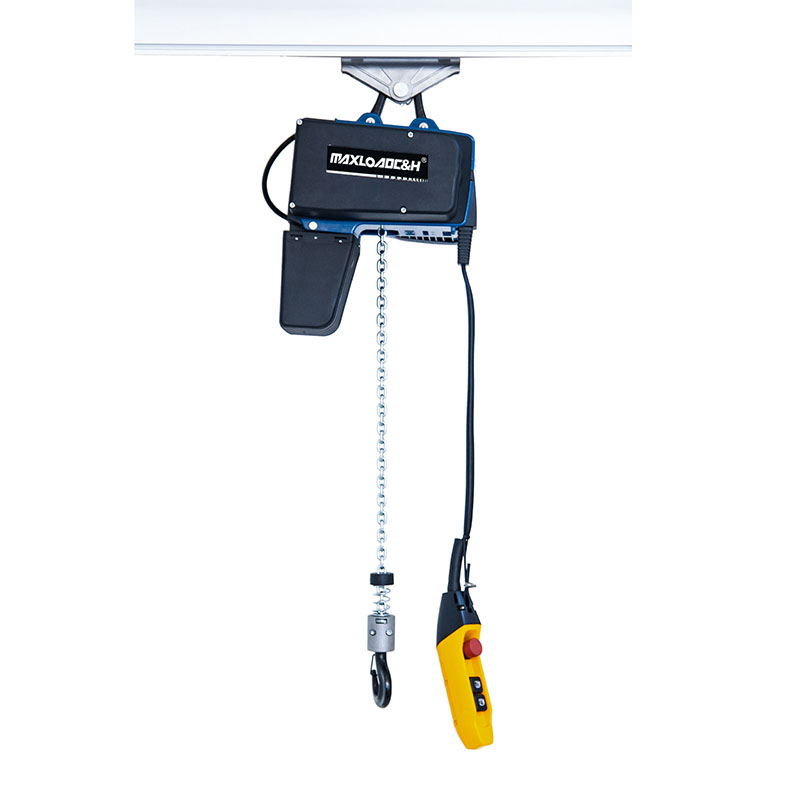
II. Lifting Height and Travel Distance: Determining the Fate of Wire Ropes and Rails
The workspace's lifting height and travel distance directly affect the fatigue life of the wire rope and the overall operational stability of the hoist.
First, consider lifting height. The greater the lifting height, the more layers of wire rope are wound onto the drum. During multi-layer winding, the extrusion and friction between layers significantly accelerate rope wear. If your workstation has a lifting height exceeding 9 meters, but you choose a standard hoist with single-layer winding, the wire rope's service life could be shortened by more than 50%. In this case, a solution with a rope guide or double-layer winding design is needed, and the wire rope diameter and tensile strength grade should also be increased accordingly.
Now consider travel distance. If the workstation involves long-distance horizontal transport, with the hoist frequently shuttling back and forth on an I-beam track, the power of the travel motor, gearbox ratio, wheel material, and wheel load distribution become crucial. Under long-travel conditions, wear on the wheel flanges and the sides of the track is the primary failure mode. During selection, special attention should be paid to whether the wheel hardness matches the track, and whether details like bearing grease fittings are included.
An easily overlooked point: the combination of lifting height and travel distance determines the cable configuration. When travel exceeds a certain length, the standard cable trolley towing method may cause cable breakage or wear due to the cable's own weight, necessitating the use of flat cables or a conductor bar power supply system.
III. Mounting Type: Fixed vs. Traveling
Electric hoists are divided into fixed and traveling types based on mounting. This choice is almost entirely determined by the workspace layout, but many users opt for more complex solutions "just in case," incurring unnecessary costs.
Fixed hoists are mounted on a fixed suspension point and can only perform vertical lifting and lowering, without horizontal movement. Their advantages are simple structure, low cost, and fewer potential failure points. They are suitable for scenarios where workpieces are vertically lifted from one fixed station to another, while horizontal transport is already handled by conveyors or AGVs. If horizontal transport is already solved and the lifting points are fixed, a fixed hoist is the most rational choice.
Traveling hoists move along an I-beam track, enabling both vertical lifting and horizontal transport. Their mechanical structure and electrical control system are more complex, and thus more costly. The only valid reason to choose a traveling hoist is that the workspace requires the hoist itself to move horizontally while carrying a load. Without this specific need, it is unnecessary to pay for functionality "just in case it's needed later."
There is also a compromise option: manual traveling hoists, where the trolley movement relies on manual pushing rather than a motor. This solution offers high cost-effectiveness for small to medium tonnage, short travel distances, and low-frequency use, providing horizontal movement capability while saving the cost of the travel motor, gearbox, and frequency inverter.
The core principle is: the complexity of the mounting type must correspond one-to-one with the actual handling path in the workspace. Every extra turn or incline in the path can exponentially increase equipment costs and the probability of failure.
IV. Power Supply Method: A Critical Variable Under Constrained Conditions
The choice of power supply method is not merely an "internal electrical affair"; it is directly constrained by the physical conditions of the workspace environment.
The most common cable power supply is suitable for most standard workstations, but with one prerequisite: there must be no obstacles below the hoist's travel path that could snag or entangle the cable. If there is equipment, racks, or frequent personnel traffic under the hoist's path, the drooping cable poses a safety hazard, and repeated bending can lead to core wire breakage.
Conductor bar power supply is more suitable for long travel distances, high frequency, or harsh environments. The conductor bars run along the track; power is collected via a current collector, eliminating cable droop and the risk of cable snagging. However, the initial investment is higher and installation precision requirements are stricter.
For outdoor or exposed workstations, the protection rating of the power supply system must also be considered. IP54 is the basic threshold for standard indoor configurations. However, if the workstation involves water spraying, dust dispersion, or corrosive gases, the sealing rating of the power supply needs to be upgraded to IP55 or even IP65.
Additionally, if multiple hoists are operating cooperatively on the same track, the power supply scheme must consider section power supply and interlock protection—these cannot be solved simply by connecting cables.
V. The Subtle Constraints of Climate and Media
This aspect may not be critical in ordinary factory buildings, but in specific industries, it can be a decisive factor in selection.
Ambient temperature is a hard constraint. If the hoist is installed in steel smelting workshops, near glass melting furnaces, or in unheated northern warehouses during winter, ambient temperatures may exceed 50°C or drop below -20°C for extended periods. In extremely high temperatures, the motor insulation class must be upgraded from F to H, brake friction materials need to be replaced with high-temperature resistant compounds, and lubricants must be changed to synthetic base oils. In extremely low temperatures, standard grease can solidify, cable jackets become brittle, and rubber bumpers lose elasticity—all these details must be reflected in the selection specifications.
Dusty environments are another common trap. Dust in woodworking shops, feed mills, or cement packaging lines can clog motor cooling ducts and infiltrate brake clearances, leading to brake failure. In such workstations, standard fully enclosed motors are insufficient; additional dust covers or forced-ventilated motors are required, and maintenance intervals should be shortened.
Corrosive media are most easily underestimated. In electroplating workshops, pickling stations, or outdoor stockyards in marine climates, salt mist or acid fumes in the air cause progressive corrosion to structural components, wire ropes, and electrical parts. In these cases, the thickness and type of surface coating, fastener material, and electrical control enclosure protection rating all need reevaluation—standard "industrial paint" cannot withstand such conditions.
VI. Control Mode and Ergonomics
The final piece of the puzzle is the control mode. It does not directly determine whether the hoist "can work," but it significantly affects whether operators "want to use it" and "might make mistakes."
Wired pendant control is the most basic option, offering the lowest cost and highest reliability. However, if the lifting height is great, the operator on the ground must look up and may have their view blocked by the workpiece itself, making it difficult to see the upper limit position. Prolonged work can also strain the operator's neck.
Wireless remote control addresses issues of line-of-sight obstruction and operator fatigue, allowing the operator to position themselves at the best vantage point within the workspace, enhancing safety. However, wireless signals may be unstable in environments with strong electromagnetic interference—an aspect that must be field-tested before selection.
Cab operation is only suitable for heavy tonnage or special applications and is overly redundant for conventional industrial hoists, so it is not discussed here.
On the ergonomic level, other details to consider include: whether the button layout matches the operator's dominant hand, whether the emergency stop is sufficiently prominent, and whether there is a fine-speed creep mode for precise positioning. These details directly affect daily operational efficiency and the likelihood of misoperation. It is advisable to have the actual operators participate in trial operation during selection.
Conclusion
Electric hoist selection is essentially a process of mapping workspace environment parameters one-to-one onto equipment configuration parameters. Rated lifting capacity is just the entry ticket; what truly determines the equipment's long-term performance is the comprehensive matching of six dimensions: duty class, lifting height and travel, mounting type, power supply conditions, environmental media, and operating habits.
Rather than repeatedly repairing and passively responding to issues after the equipment fails, it is far better to invest an extra day during the selection phase to thoroughly understand the workspace environment and accurately specify the parameters. A lifting solution highly compatible with the environment may have upfront communication costs accounting for only 5% of the total equipment cost, but the downtime losses and safety risks it prevents could be ten times that amount or more.
The workspace environment is not a mere reference item in selection; it is the decisive factor. Only by clearly understanding this logic can you select a hoist that is durable, smooth-running, and worry-free.
 0086 156 1824 5535
 0086 156 1824 5535
 kimliu@chnhoist.com