Professional Selection Guide for Electric Chain Hoists
In the selection of workstation lifting equipment, a common misconception is to focus only on the parameter of "load capacity." In reality, even for an electric chain hoist with the same rated load of 1 ton, the configuration differences between one used at an ordinary assembly workstation and one used in a cleanroom can be far greater than imagined. The workstation environment not only affects the service life of the equipment but also directly relates to operational safety, production efficiency, and operating costs.
The selection of an electric chain hoist is essentially a process of "environment matching." Starting from the perspective of the workstation environment, this article outlines a practical selection logic.
I. First Define the Workstation's Duty Intensity: The Duty Class Is the Starting Point for Selection
Before discussing environmental factors, it is necessary to clarify a prerequisite that is easily overlooked: how much work will this hoist actually do at the workstation?
In international standards, the duty class of an electric hoist is determined jointly by the load spectrum and the utilization class, ranging from light duty to extra-heavy duty. In plain terms, if the workstation only lifts a few workpieces each day and rarely operates at full load, that is completely different from hundreds of cycles per day and long-term operation close to full load. The equipment required for these two scenarios is entirely different.
The key parameters for determining the duty class include: number of cycles per hour, average lifting height, and load distribution. A simple estimation method is: if the motor starts and stops frequently and heat dissipation conditions are poor, the motor temperature rise may exceed the limit even if the load is not large. Therefore, during selection, one should not only look at "how heavy the maximum lift is," but also evaluate "how many lifts per day, how long each lift lasts, and whether the intermittent time is sufficient."
For ordinary assembly workstations, light duty or medium duty is usually sufficient; however, for scenarios such as casting, mold changing, and high-frequency assembly lines, a higher duty class should be selected. Otherwise, motor overheating and brake wear will significantly shorten the equipment's service life.
II. Environmental Protection Rating: The Practical Meaning Behind the IP Code
The protection rating is a core indicator of an electric hoist's adaptability to the environment, but many users' understanding of it remains at the level of "the higher the number, the better." The IP code consists of two digits. The first digit represents the ability to prevent the ingress of solid foreign objects, and the second digit represents water resistance.
In ordinary dry workshops, an IP54-rated hoist can already meet basic needs. However, the following workstation environments require special attention:
Humid or outdoor environments. When the workstation has risks of condensation, oil mist, or rain intrusion, the protection rating should be increased to IP55 or higher. Shipboard workstations are an extreme case, where chain hoists need to operate normally under conditions of 95% relative humidity with salt spray and mold, and the motor insulation class must reach Class F or higher. Although ordinary workstations do not need to be this stringent, scenarios such as washing stations, cold storage, and basements also require attention to moisture protection. Dusty workstations. Workstations such as casting, grinding, and powder material handling contain large amounts of particulate matter. Dust entering the interior of the motor will accelerate insulation aging, and dust entering the brake will cause braking torque to decrease. Totally enclosed fan-cooled motors (TEFC) and enclosed brakes are standard equipment for such environments. If the dust is conductive or corrosive, the enclosure level needs to be further improved.
High-temperature workstations. The ambient temperature near workstations such as metallurgy, glass, and forging may far exceed the tolerance range of conventional motors. Ordinary motors are designed for an ambient temperature of 40°C. High-temperature workstations require the selection of high-temperature-resistant insulation systems, or motors with thermal protection sensors, and if necessary, the addition of heat insulation baffles.
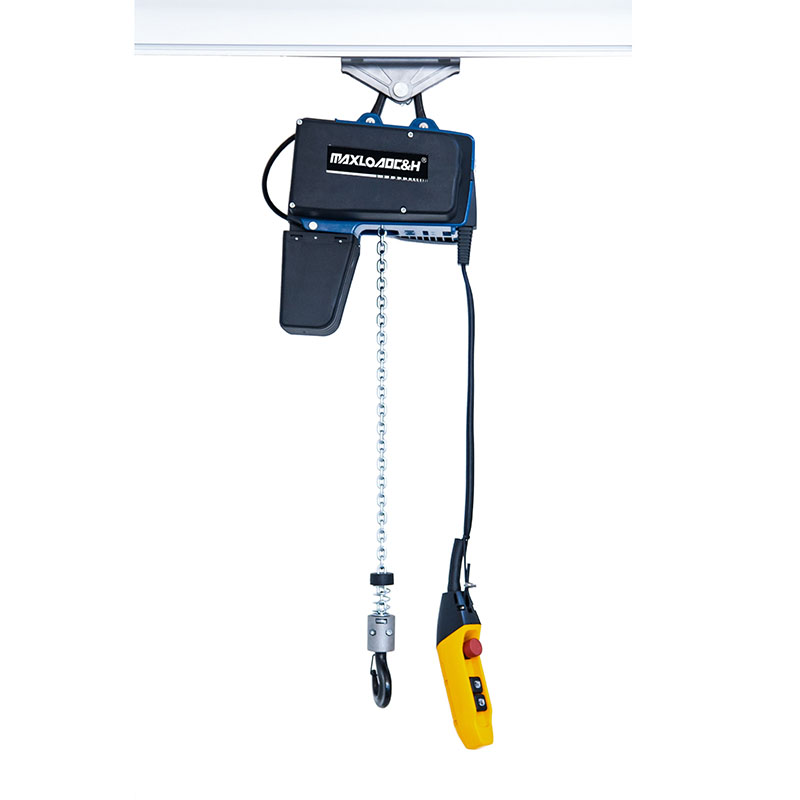
III. Cleanliness Constraints: When the Hoist Becomes a Source of Contamination
There is a category of workstations with relatively special requirements for lifting equipment: it is not that the environment will damage the hoist, but that the hoist may contaminate the environment.
Workstations such as electronic component assembly, pharmaceutical production, food processing, and precision optics have strict requirements for air cleanliness. An ordinary chain hoist becomes a risk source here: friction between the chain and chain wheel generates metal particles, lubricating grease volatilizes to form chemical contamination, and dust accumulates on the housing surface and is difficult to clean.
The selection logic for such workstations needs to shift toward "contamination-prevention design": the housing uses stainless steel or special coatings, with a smooth surface and no dead corners for easy wiping and disinfection; the chain is equipped with a fully enclosing protective cover to confine wear particles inside; the lubricant uses special low-volatility grease; and the sealing level of electrical components usually needs to be above IP65. Some special scenarios also require that parts in contact with materials do not contain specific metal elements such as copper and zinc, so as to avoid catalytic contamination of sensitive processes.
During selection, buyers for clean workstations should proactively explain the cleanliness level and contamination control requirements to the equipment supplier, rather than assuming by default that "the standard model will also work."
IV. Space Conditions: The Choice Between Headroom and Operating Mode
The physical space of the workstation directly determines the installation form and operating mode of the hoist.
Workstations with limited headroom. In old factory renovations, low warehouses, and assembly lines with dense equipment, the available space at the top is often very limited. In this case, a low-headroom chain hoist is a reasonable choice. Its compact structure can secure a greater effective lifting height within limited vertical space. If a standard hoist is forced into use, the hook may be unable to raise the workpiece to the required height.
Workstations requiring horizontal movement. Fixed hoists are sufficient for fixed-point lifting; however, if the workstation needs to cover an area, a traveling trolley is required. Manual push trolleys are suitable for scenarios with low movement frequency and moderate loads; electric trolleys are used for frequent movement or heavy-load horizontal transport. During selection, attention should also be paid to whether the track form matches the trolley, and the specifications of the I-beam track must be confirmed before purchase.
Cantilever workstations and assembly lines. A jib crane combined with a chain hoist is a typical workstation lifting solution. Such applications require attention to the hoist's headroom dimensions and dead weight. An excessively heavy hoist will reduce the effective load capacity of the jib.
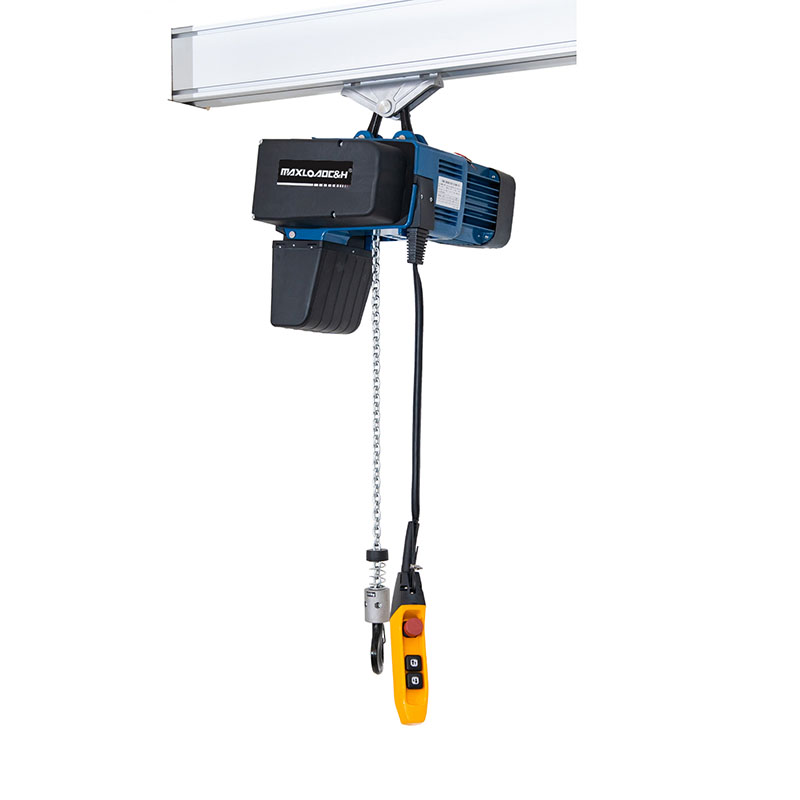
V. Operating Frequency and Speed Requirements: The Trade-Off Between Dual Speed and Variable Frequency
The choice of lifting speed is often simplified to "faster is better" or "slower is more stable," but actual workstation needs are more nuanced.
Single-speed hoists are suitable for simple lifting operations that do not require high positioning accuracy and have a fixed lifting height. Dual-speed hoists provide two speeds: fast and slow. The fast speed is used to improve efficiency during empty hook or light-load operation, and the slow speed is used for fine adjustment when placing heavy objects in position. At assembly workstations and mold-changing workstations, the accuracy of slow-speed fine adjustment is often more important than fast lifting. If the workstation has higher requirements for speed control—for example, stepless speed regulation, soft start and soft stop, and anti-sway functions—then variable-frequency control is a more suitable choice. Variable-frequency hoists have obvious advantages in starting and braking smoothness, positioning accuracy, and mechanical impact control, at the cost of slightly higher initial cost and maintenance complexity.
Operating frequency also affects the control method. Fixed workstations can use pendant control; when the operator needs to observe the lifting status from different positions, wireless remote control can significantly improve the operating experience and safety.
VI. Selection Checklist: Return to the Workstation Itself
Integrating the above dimensions, to select a suitable electric chain hoist for a workstation, the requirements can be sorted out in the following order:
Clarify load and travel. The rated load capacity should be based on the weight of the heaviest workpiece, taking into account the weight of the lifting device and possible future load changes. The lifting height determines the chain length and needs to be calculated from the actual travel from the lowest hook position to the highest hook position.
Evaluate work intensity. Based on the number of cycles per hour and daily working hours, determine the required duty class. It is better to choose a higher class than a lower one, because failures caused by insufficient duty class usually only become apparent after several months of use, and by then it is difficult to remedy.
Match environmental protection. Based on factors such as humidity, dust, temperature, and corrosive gases at the workstation, determine the IP rating, insulation class, and material requirements. Clean workstations require a separate assessment of the contamination control plan.
Confirm space and operating mode. Measure the workstation's headroom and horizontal coverage, choose fixed, traveling, or low-headroom type, and confirm the track interface.
Choose speed and control. Based on positioning accuracy requirements and operating frequency, decide among single speed, dual speed, or variable frequency, as well as pendant or remote control operation.
In the final analysis, the selection of an electric chain hoist is about understanding the needs of the workstation. If the environmental conditions are clearly explained, half the selection work is already done.
 0086 156 1824 5535
 0086 156 1824 5535
 kimliu@chnhoist.com