Starting from the Workstation Environment: Four Core Dimensions for Judgment
Walk around a workshop or warehouse, and you will notice a phenomenon: with the same electric hoist paired with an overhead crane, some workstations use it very smoothly—workers operate with ease, positioning is accurate, and there are few failures; other workstations, however, have constant problems—either the hook cannot reach a corner, or during frequent inching operation it sways so much that it cannot be aligned, or the motor starts overheating in less than a year. The equipment itself may be fine; the problem is whether the workstation environment was truly understood during selection.
The differences between workstation environments are far greater than imagined. For the same 5-ton lifting capacity requirement, a mold repair workstation and a continuously producing assembly line workstation have almost completely different requirements for the equipment. The following discusses, from four dimensions, practical methods for judging the selection of electric hoists and overhead crane combinations.
Spatial conditions determine "whether it can be installed and whether it can reach after installation"
The spatial conditions of a workstation have two levels: the upper structure and the planar layout.
For the upper structure, the first thing to check is the load-bearing capacity of the factory roof. If the workshop has a concrete roof or a steel beam structure and the load margin is sufficient, the suspension scheme is the most economical choice; the track can be hung directly from the beams through connectors. But if it is a renovated workshop or there are dense pipelines above the ceiling, the situation becomes more complicated—air conditioning ducts, fire protection pipes, and cable trays may all occupy suspension point locations. In this case, either add suspension points to distribute the load, or consider a self-supporting structure that transmits the load directly to ground columns and no longer depends on the factory roof.
Clear height is another easily underestimated constraint. A suspension crane itself occupies a certain amount of vertical space. If the area above the workstation is already low, then after adding the crane and hoist, the hook's maximum lifting height may be only one or two meters, making even normal lifting impossible. A low-headroom design hoist is a necessary choice in this situation; it can compress the equipment's own height occupation as much as possible and leave the precious clear height for the hook travel. The impact of the planar layout is equally direct. A regular rectangular workstation can be covered with a straight track, but many workstations have shapes that are not regular—L-shaped production lines, circular assembly areas, and even height differences between workstations. Standard straight tracks will create "unreachable" dead corners in these scenarios. Curved tracks, switches, and turntables are components prepared for irregular layouts. A practical principle is: the track coverage area should be at least thirty to fifty centimeters larger than the actual working area; otherwise, when operating at corner positions, personnel will clearly feel the awkwardness of "just missing that little bit."
Load characteristics deserve more attention than rated lifting capacity
When selecting, looking only at "how many kilograms the heaviest load is" is the most common and also the most dangerous simplification. The motion characteristics of the load are equally critical.
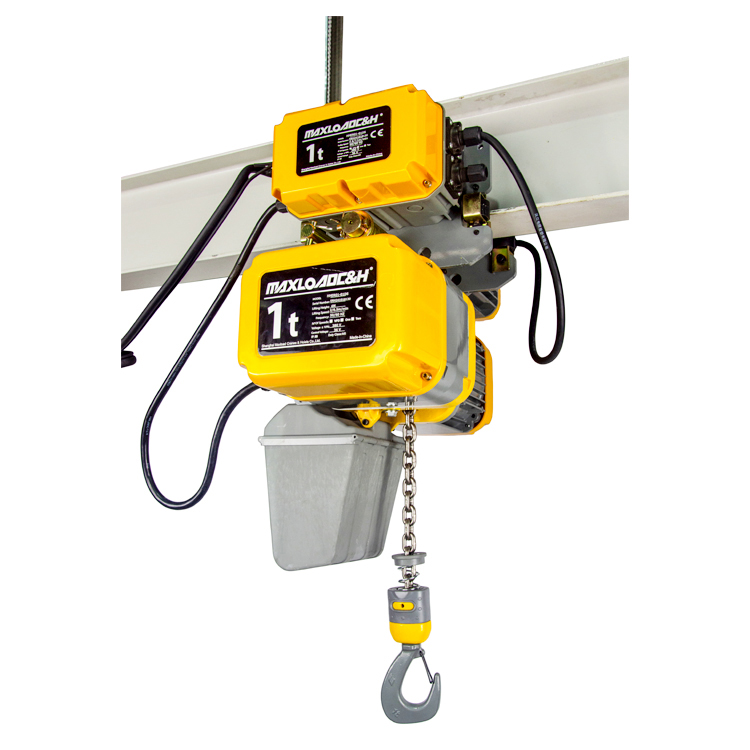
Is the heavy object prone to swinging? Loads such as long workpieces, molds with offset centers of gravity, and liquid hoppers will produce obvious inertial swinging when lifting and stopping. The starting and braking of ordinary hoists are "switch-type," and even more so during inching operation; the heavy object will sway along with it, making positioning extremely difficult. For such loads, the value of a variable-frequency speed-controlled hoist becomes apparent—acceleration and deceleration can be made gentle, and when the heavy object reaches the target position, it will not swing back and forth.
Is fine positioning required? Some workstations only move heavy objects from A to B and just need to place them steadily. But other workstations, such as mold assembly, loading workpieces onto machine tools, and loading and unloading measuring machines, often require positioning accuracy at the millimeter level. The inching control of ordinary hoists is almost incapable of handling this scenario, because every inching operation is accompanied by an uncontrollable amount of displacement. A hoist with slow/fast speeds or stepless speed regulation can achieve the control feeling of "move a little with each touch."
There is also a counterintuitive selection principle: the rated lifting capacity of the hoist should not be much larger than the actual maximum load. Some people think "leaving sufficient margin is safer," so they install a 2-ton hoist at a 500-kilogram workstation. As a result, the hoist's own weight and volume are considerably larger; the small workstation is packed so tightly by the equipment that there is no room to turn around; and the large-specification hoist's low-speed control accuracy is often actually worse. A reasonable approach is to let the maximum load fall between 50% and 80% of the rated lifting capacity, which both leaves a safety factor and ensures controllability.
Usage frequency is a dividing line, not something where "about the same is fine"
The usage frequency of workstation lifting equipment varies enormously. A maintenance workstation may be used two or three times a day, while an assembly line workstation may need to lift once every two minutes. These two scenarios have completely different requirements for the equipment.
For low-frequency workstations, such as equipment maintenance and laboratory preparation areas, there is no need to pay a premium for continuous duty. An ordinary conical rotor motor electric hoist with working class M3 or M4 is sufficient, and with simple single-speed control it can fully meet the needs.
But high-frequency workstations are another matter. Dozens or even hundreds of lifting and travel operations every day on an assembly line test motor heat dissipation, brake life, and travel wheel wear resistance. The motor working class should be at least M5, the brake wear margin should be sufficient, and the material and heat treatment of the travel wheels should also keep up. High-frequency workstations also have a hidden cost: the pendant control cable. Ordinary PVC-sheathed cables may develop cracks within a few months under frequent back-and-forth bending with the trolley. Switching to reinforced rubber-sheathed cables or conductor rail power supply requires a little more initial investment, but avoids the downtime and high labor costs of frequent cable replacement.
Environmental factors are often ignored during selection and only exposed during operation
Temperature, dust, humidity, and corrosive atmospheres all have corresponding protection ratings or material options in equipment manuals, but during actual selection they are often glossed over with "just use the conventional one for now."
In high-temperature environments, such as casting or forging workstations, the heat dissipation capacity of ordinary motors will noticeably decline. In summer, combined with ambient radiant heat, the motor temperature rise can easily approach the limit, and frequent overheating trips will directly interrupt the production rhythm. Such workstations require high-temperature-resistant motors, and both the insulation class and temperature rise limits should have a margin.
The impact of dusty environments is more concealed. Fine particles in grinding workstations and powder handling areas will enter motor bearings and brake gaps, accelerating wear, causing brake clearance to increase and braking torque to decrease. In dusty environments, the hoist protection rating should be at least IP55, and the track travel wheels had better have track-cleaning devices; otherwise, after dust accumulates on the track, the trolley running resistance will noticeably increase.
In humid and corrosive environments, such as electroplating, pickling, or workshops in coastal areas, ordinary galvanized fasteners and paint coatings will not last long. Exposed metal surfaces require additional anti-corrosion treatment, and the sealing level of electrical control boxes should also be increased accordingly. If the workshop also contains flammable and explosive gases or dust, an explosion-proof electric hoist is a mandatory requirement, not an option. The motors, brakes, and electrical boxes of explosion-proof hoists are all explosion-proofed. If the crane is also in a hazardous area, it must likewise have an explosion-proof rating, and the explosion-proof levels of the two must match.
Common pitfalls when matching
The matching of electric hoists and overhead cranes is not "choose each separately and just install them." Several common mismatches deserve attention.
The matching of the hoist's travel wheels with the crane track is the first hurdle. I-beam specifications and models vary widely, and the wheel flange spacing of the hoist trolley must correspond to the flange width of the track. A wide track with narrow wheels will result in a small contact surface and rapid wear; a narrow track with wide wheels may not fit in at all. During installation, a gap of usually 1 to 2 millimeters is left between the wheel flange and the track flange; too tight increases running resistance, while too loose makes deflection likely.
When pairing a double-girder crane with an electric hoist, attention must also be paid to whether the hoist dimensions can fit between the two main girders. The spacing between the double girders and the hoist's outer width needs to be checked in advance to avoid discovering on site that it cannot be installed. In addition, if the crane's long travel speed and the trolley's cross travel speed do not match, operation will produce a disjointed feeling of "the crane has moved but the trolley has not yet moved," and the lifting path will not be smooth. Speed coordination should be confirmed at the selection stage, rather than compromised later during commissioning.
Track-end buffers and limit devices also cannot be omitted. If the electric hoist's travel trolley has no reliable stopping device at the end of the track, one misoperation may cause it to run directly off the track. Elastic buffers are the minimum configuration; when conditions permit, an electric cross limit switch can provide more reliable protection.
In the end, selection is engineering judgment, not table lookup
There is no standard answer for the combination scheme of an electric hoist plus overhead crane. For the same 5-ton, 10-meter span requirement, placed in a mold warehouse, assembly line, electroplating workshop, or explosion-proof area, the selected equipment may be completely different. The key is to return to the real scenario of the workstation: whether space is sufficient, whether the load swings, how many times it is used per day, and what special features the environment has. Once these questions are clarified one by one, the configuration scheme will naturally become clear.
Before finally placing the order, talking with on-site operators is often more useful than flipping through catalogs. They know "the hook always just misses reaching over there," and they also know "during inching it sways so much that it simply cannot be aligned"—this real feedback from daily operation is selection evidence that no technical parameter table can replace.
 0086 156 1824 5535
 0086 156 1824 5535
 kimliu@chnhoist.com