The Logic of Electric Hoist Selection
Selecting an electric hoist can be complicated or simple, depending on how you approach it. Many people, when making a purchase, habitually look at the tonnage first, thinking that "as long as it can lift the load, it's fine." As a result, only after the equipment is installed do problems emerge: either the hook cannot rise to the desired height, or the motor burns out after only a few months, or the chain jams in a dusty environment. Where do the problems come from? They come from treating the electric hoist as an isolated commodity rather than considering it within the specific workstation environment. The same 2-ton hoist, installed at an assembly workstation in a machining workshop and installed next to a reactor in a chemical plant, requires two completely different pieces of equipment. This article does not discuss brands, only logic. Starting from the workstation environment, it breaks down the matter of selection.
First, look above the workstation: space determines the hoist's "form"
Electric hoists are divided into two major categories by winding method: wire rope type and chain type. This choice first depends not on what you are lifting, but on how much space there is above the workstation.
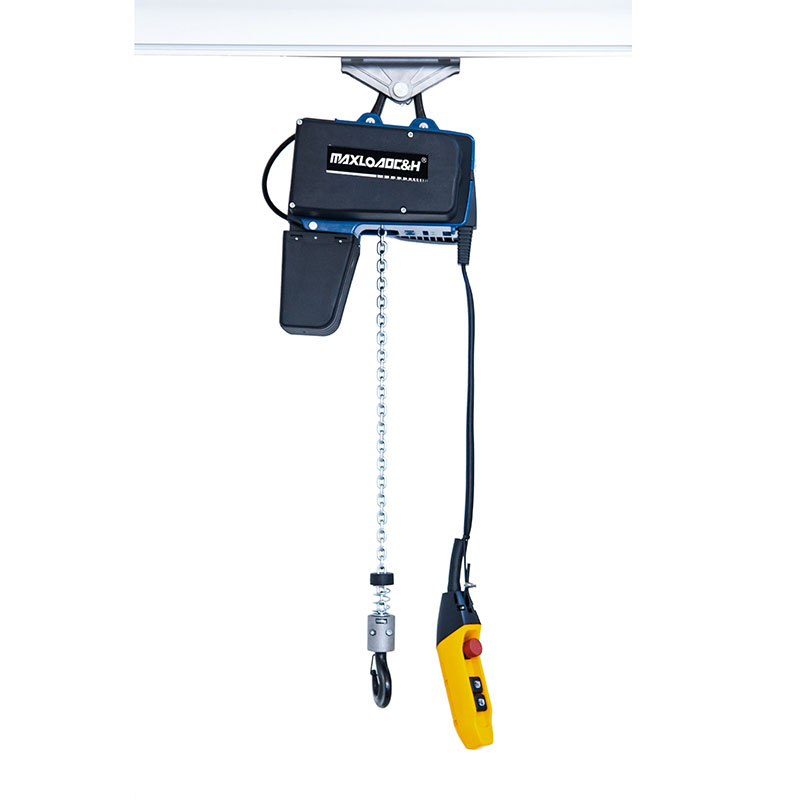
The drum of a wire rope electric hoist requires at least three full wraps of wire rope as a safety reserve, which means that its axial dimensions are inherently one size larger than those of a chain type. If your workstation is in an old factory building and the distance from the roof beam bottom to the rail is already tight, installing a wire rope hoist may mean the hook cannot even guarantee a lifting height of 1.5 meters. In this case, a low-headroom chain electric hoist is the only choice. Its sprocket structure greatly compresses the body thickness, allowing the precious vertical space to be used for effective lifting travel.
Conversely, if the workstation is in a standard factory building with ample clear height under the beam, a wire rope hoist is actually more suitable. Its upper limit for lifting height is higher, and its operation is smoother, making it suitable for long-distance vertical lifting.
Here is a detail that is easily overlooked: when calculating clear height, you cannot measure only the distance from the beam bottom to the ground. Ventilation ducts, cable trays, and fire sprinkler pipes above the workstation—any protruding obstacle will eat into your
effective lifting height. Reserving a safety margin of 200 to 300 millimeters is the bottom line; otherwise, when the hook with the workpiece rises to the top, what it hits first may not be the limit switch, but the air duct.
Next, look at what is in the workstation: the environment determines the hoist's "constitution"
The impact of the workstation environment on an electric hoist is much greater than most people expect. The motor and electrical components of an ordinary electric hoist usually have a protection rating of IP44, meaning it can block solid particles larger than one millimeter and water splashing from all directions. This rating is sufficient in a dry and clean assembly workshop, but it cannot hold up in other environments.
Dusty environments
In grinding workstations, foundry workstations, and grain processing workstations, fine suspended particles in the air will penetrate through the motor's cooling gaps. Once these dust particles accumulate inside the motor, at best they affect heat dissipation and cause overheating, and at worst they adhere to bearings and brakes and cause jamming. To cope with dusty environments, the protection rating should be raised to at least IP54—completely preventing contact with internal live parts, with harmful dust deposition not affecting normal operation. If it is conductive dust or high-concentration combustible dust, higher levels of sealing and even explosion-proof design need to be considered.
Humid and corrosive environments
In electroplating workstations, cleaning workstations, and pickling workstations, the corrosion caused by moisture and acid-base vapors in the air on electric hoists is continuous. The metal casing and electrical contacts of ordinary hoists will accelerate in rusting and oxidation in such environments. The protection rating needs to be raised to IP55, and the motor should also be considered for adding a preheating and drying device to prevent internal condensation during shutdown periods.
An easily overlooked link is the lifting attachment. In corrosive environments, the materials of the hook and chain also need to match. Stainless steel hooks or chains treated with special coatings cost more, but they are more cost-effective than replacing corroded lifting attachments once every six months.
Explosive gas or dust environments
This is the scenario in which selection can least afford compromise. In chemical workshops, paint booths, and workstations where flammable gases or dust exist, the tiny sparks generated by motor commutation and contact opening and closing during ordinary electric hoist operation are potential ignition sources. The core logic of an explosion-proof electric hoist is not "preventing sparks from being generated," but "even if sparks are generated inside, sealing them within an explosion-proof enclosure." During selection, it must be confirmed that the equipment has an explosion-proof marking matching the hazardous area classification of the workstation, as well as an explosion-proof certificate issued by an authoritative organization.
Then, look at how the workstation works: frequency determines the hoist's "endurance"
The motor of an electric hoist is not designed for continuous operation. It relies on intermittent work for heat dissipation, and the duty cycle parameter directly determines the pace at which the equipment can operate.
The FEM standard divides the working class of electric hoists into several levels from M3 to M6, corresponding to theoretical full-load operating times ranging from 400 hours to 3,200 hours. This number sounds very large, but when converted to actual workstations, the differences immediately become apparent.
A warehouse loading and unloading workstation may only lift goods a dozen or so times a day, with each operation lasting a few dozen seconds, so M3 level is completely sufficient. But at an assembly workstation on a production line, where workpieces must be lifted every two minutes, the lifting mechanism may operate hundreds of times a day, and the motor has almost no time for adequate cooling. Under such working conditions, if an M3 hoist is selected, the motor will operate in a state of long-term heat accumulation, the winding insulation will age faster, and problems will appear before long. High-frequency workstations should choose M4 or M5 levels, where the motor and brake have a larger design margin and can withstand denser work cycles.
The choice of working class is also related to speed control. Low-frequency intermittent workstations can use single-speed hoists, which are simple in structure and have a low failure rate. But if it is a workstation requiring precise positioning—such as lifting a workpiece onto a fixture, mold alignment, or precision assembly—the "press and it lunges" behavior of a single-speed hoist makes operation very difficult. Dual-speed or variable-frequency hoists can achieve millimeter-level fine adjustment in the slow-speed gear, allowing the operator to calmly place the workpiece in the exact position and avoid collisions.
Finally, calculate an account with margin
There is a simple but easily violated principle in tonnage selection: do not choose the rated capacity based on the maximum lifting weight.
What is actually lifted at the workstation includes not only the workpiece itself, but also the weight of the lifting attachments. Hooks, fixtures, and rigging—these together may weigh more than the workpiece. The dynamic load impact at the moment of lifting—the instant the workpiece leaves the ground—means the actual load will exceed the static weight. If the workstation has vibration conditions or frequent full-load operations, these factors combined mean that a hoist selected to be "just enough" will quickly reveal problems.
For conventional intermittent working conditions, it is recommended to reserve a margin of 25 percent; for frequent operations or vibration conditions, increase the margin to 50 percent. This is not conservatism; it is calculating a long-term account: a hoist selected one size larger differs only slightly in price, but it will not frequently fail because it operates long-term near full load, and the workstation will not be interrupted because of equipment downtime. No matter how you calculate it, this account is more cost-effective than "just right."
In the final analysis, the logic of electric hoist selection is not to find the "best" equipment, but to find the equipment that is "least strained." Not strained in space, not strained in environment, not strained in work rhythm, not strained in load. When all four items match, this hoist will work quietly at the workstation and not cause you trouble. If even one of the four is compromised, it will always come back somewhere unexpected later.
 0086 156 1824 5535
 0086 156 1824 5535
 kimliu@chnhoist.com