Workstation Environment Determines Everything — Electric Hoist Selection
In electric hoist selection, mistakes are more often than not made not in the tonnage, but in the environment. If you choose the wrong tonnage, the worst case is replacing the unit. If the environment is misjudged, the consequences range from frequent downtime to safety accidents. The workstation environment determines the physical form, protection rating, and service life of the hoist, and these three in turn constrain what you can choose and what you cannot use.
Look at space first, not tonnage
Most people start selecting a hoist by looking at the lifting capacity: lift two tons and choose a two-ton unit. Simple and direct. But the first constraint of the workstation environment is often space, not weight.
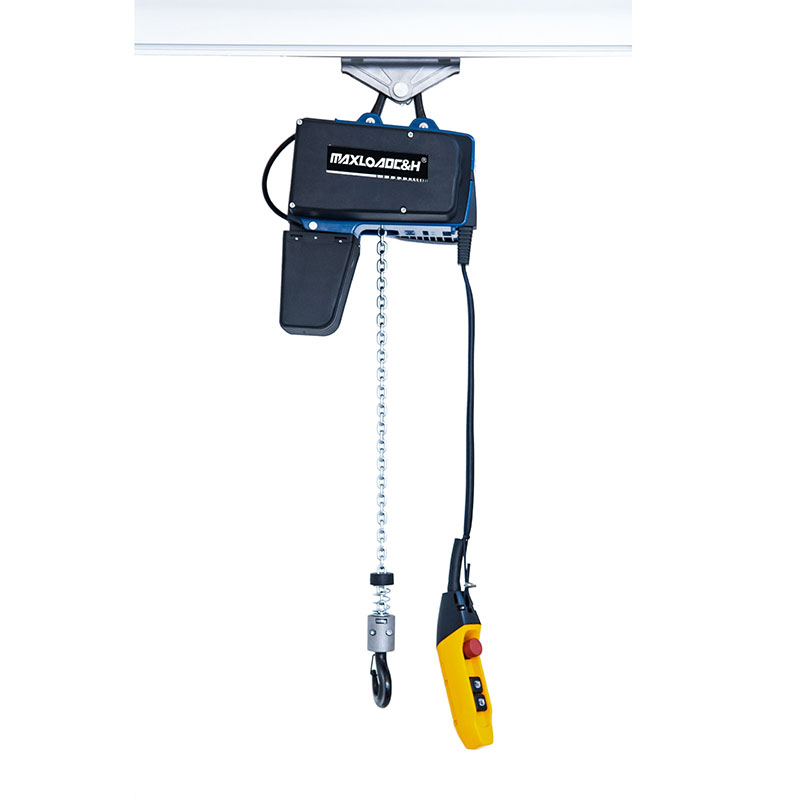
Clearance height is a hard constraint. The clear height of a standard I-beam single-girder workstation is usually between 500 and 800 mm. If the distance from the roof beam to the floor in your factory is only 4.5 meters and the workpiece itself is 1 meter high, a conventional electric hoist alone consumes 600 to 700 mm of that, so the actual lifting height may be less than 3 meters. This is where the value of low-headroom models lies: by compressing the hoisting mechanism into the trolley frame, the distance from the hook to the lower edge of the rail can be controlled to 200 to 400 mm. Do not underestimate those extra 300 mm saved; it may be the difference between "being able to lift it" and "not being able to reach the workbench."
The method of judgment is straightforward: use a tape measure to determine the distance from the lower edge of the rail to the highest point of the workpiece, then subtract the height occupied by the rigging and hook. If the result is less than 1.5 meters, a low-headroom model is mandatory, with no room for negotiation.
The running rail determines the installation form. Is the workstation a single-girder I-beam or a double-girder bridge? Is the rail straight or does it have curves? A manual push trolley type is suitable for low-frequency, short-distance straight-line workstations; a motorized trolley type is suitable for assembly lines requiring frequent lateral movement. If your workstation requires turning, you must confirm in advance whether the hoist can adapt to curved rails. This is not something that can be changed later.
Environmental class determines how long it lasts more than tonnage does
The same three-ton hoist can last eight years in a dry assembly workshop, but may be scrapped in three years on an electroplating line. The damage that environmental corrosiveness and hazard cause to hoist service life far exceeds most people's expectations.
The dividing line between ordinary workshops and corrosive environments. For indoor, dry workstations without corrosive gases, ordinary standard models are sufficient. However, the following types of environments require upgraded protection: processes such as electroplating, acid pickling, and printing and dyeing that involve acid or alkali gases require anti-corrosion treatment, including housing coatings, stainless steel chains, or galvanized chains; high-humidity and washdown environments in food processing and pharmaceutical workshops require a protection rating of at least IP55, with IP65 recommended for control handles; high-temperature workstations such as casting and forging require confirmation of whether the motor insulation class and cooling method can withstand radiant heat.
Judging hazardous areas allows no room for "roughly." Painting workshops, chemical raw material warehouses, and grain processing or metal grinding workstations with high dust concentrations contain explosive gas or dust environments. Such workstations must use models with the corresponding explosion-proof certification, and the explosion-proof rating must match the on-site hazardous area classification. For gas environments, look at the area classification and gas group; for dust environments, look at the dust type and ignition temperature. One point is worth noting: explosion-proof hoists usually cost 2 to 3 times as much as ordinary models, but if the workstation truly belongs to a hazardous area, this money cannot be saved, nor should it be evaded with "we've always used ordinary ones before and nothing happened."
Task cycle determines the model grade
Whether the workstation "lifts something occasionally" or "lifts hundreds of times a day" corresponds to completely different model logic.
The motor design of an electric hoist is based on duty cycle. Under intermittent periodic duty, motor heating depends on the load duty ratio and the number of starts per hour. Simply put, for the same hoist, starting and stopping five times per hour versus sixty times per hour makes a world of difference in the temperature rise inside the motor. If an assembly workstation must lift a workpiece every two minutes, it may seem to be lifting only a few hundred kilograms, but the motor has almost no cooling time. In this case, choosing an economical hoist designed for "occasional lifting" will cause the motor windings to repeatedly overheat within a few months, eventually leading to insulation aging and short circuits.
The working class is the tool for quantifying this problem. Light-duty M3 is suitable for maintenance and installation workstations, lifting a few times a day; medium-duty M4 to M5 is suitable for machining workshops and general assembly lines, with dozens of cycles per day; heavy-duty M6 and above is suitable for production line workstations and high-frequency warehouse transfer. A practical judgment principle: if the workstation operator, from the start of the shift to the end, gives the hoist less rest time than working time, then skip M3 directly and start from M5. The cost increase for choosing one grade higher is about 10 to 20 percent, but the service life may be more than doubled.
Speed selection follows precision, not efficiency. Many people want it as fast as possible, but the faster the lifting speed, the greater the impact when stopping, and the harder it is to position. For precision assembly workstations that need to place workpieces accurately on fixtures, dual-speed models are almost standard: fast speed for empty hooks and large lifts, slow speed for the final few centimeters of alignment. When a single-speed model is used at a precision alignment workstation, the operator must "nudge" the position by inching every time, which damages both the contactor and the workpiece.
Two easily overlooked items: rail and power supply
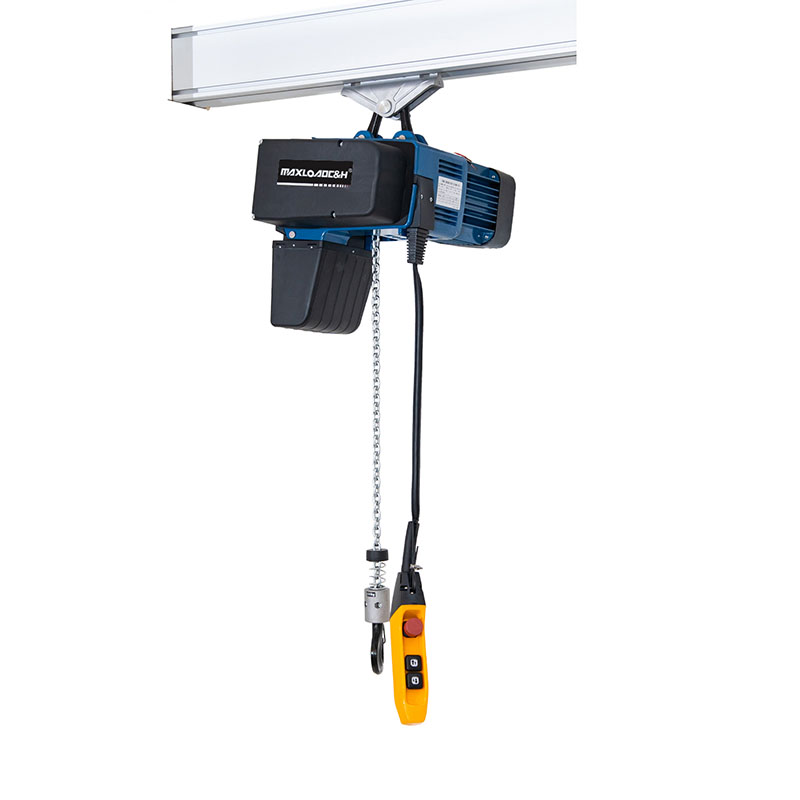
The existing I-beam rail at the workstation is a ready-made constraint. The wheel gauge and wheel flange shape of the hoist trolley must match the rail flange width. The load-bearing capacity of the rail must also be calculated: the hoist's own weight plus the rated load, multiplied by the dynamic load factor, must not exceed the allowable wheel load of the I-beam. If the rail was installed years ago according to old standards, it is best to check the original drawings or ask someone to verify it. Do not assume it can support new equipment.
The power supply is the final checkpoint. Does the workstation have three-phase 380V power? If not, single-phase 220V micro hoists are only suitable for light-load scenarios at the level of a few hundred kilograms; anything with a slightly larger tonnage cannot be driven. Even if the voltage is correct, you must also confirm whether the distance from the workstation to the control handle exceeds the cable length supplied with the hoist. If it does, the cable needs to be extended or a remote control used. This is an accessory that must be determined during selection, not a small problem to be solved temporarily after delivery.
Conclusion
The essence of choosing an electric hoist is to make the equipment adapt to the workstation, not to make the workstation accommodate the equipment. First measure the space, then judge the environment, and finally check the task cycle. Tonnage is instead the result that naturally emerges after these three dimensions are determined. Reverse the order and buy a hoist based only on tonnage, and what awaits you later is often the trouble of it not fitting, not lasting, and never stopping needing repair.
 0086 156 1824 5535
 0086 156 1824 5535
 kimliu@chnhoist.com