Decision Logic from Load Spectrum to Space Constraints
Choosing an electric hoist can sound simple—weigh how heavy the load is, measure how high it needs to go, check a catalog, and pick a tonnage. But in actual use, problems show up: the chain jams every few days, brake pads wear out fast, the hook always lands a few millimeters off, and in a low factory building the hoist simply cannot lift to the height you want after installation. The problem is that during selection, people look only at "how heavy and how high," while ignoring the workstation environment—the real constraint. Selecting an electric hoist is essentially about matching the equipment's working-capability curve to the workstation's job-demand curve. Load, frequency, space, and environment—these four dimensions together determine which type of hoist can survive well and last long at that workstation. The following breaks this down one dimension at a time.
Load Spectrum: Not "What Is the Heaviest Load It Lifts," but "What Does It Lift on Average"
Most people focus on only one number during selection: the heaviest thing the workstation needs to lift. That number is of course necessary, but it is only the starting point.
What truly determines hoist life is the load spectrum—that is, the weight commonly lifted in daily operations and how often full load occurs. The FEM standard of the European Materials Handling Federation divides load distribution into four categories: light, medium, heavy, and extra heavy. A hoist that lifts half a ton every day and occasionally lifts two tons, and a hoist that lifts two tons every day, even with the same rated tonnage, will experience completely different actual wear on internal gears and motors.
Rated tonnage selection needs a safety margin. For conventional working conditions, choose based on maximum lifting weight multiplied by 1.25. If the workstation has strong vibration and frequent starts and stops, the margin should be increased to 1.5 times. But the margin is not better the larger it is—if the tonnage is selected too large, it actually wastes electricity when lifting light loads, and the lifting speed appears slower. The precise selection method is: first calculate the average daily actual working time and average load, then compare with the working-level table to select a matching model.
Space Constraints: Clearance and Coverage Determine the Form
The available space at the top of the factory building is the hardest constraint in selection.
The drum of a conventional wire rope hoist requires the wire rope to be wound at least three turns for normal rope payout. This determines that the drum itself has a minimum axial length, and the body thickness cannot be reduced. If the factory building is an old renovation project, or if floor height was reduced during new construction to save cost, and there are still pipes and cable trays under the ceiling, then after a conventional wire rope hoist is installed, the hook's upper limit may be too close to the ground, and the actual effective lifting height may be insufficient.
The low-headroom chain hoist exists precisely for this scenario. The chain drive method uses a sprocket to drive the chain. The axial dimension of the sprocket is only about 1.6 times the chain width, and the maximum wrap angle between the chain and sprocket does not exceed 270°. It does not need to be wound multiple turns on a drum like wire rope. The body can be made very thin, and the hook can rise to a position closer to the lower edge of the track. In a low factory building, this difference may be the difference between "it can lift" and "it cannot lift above the equipment."
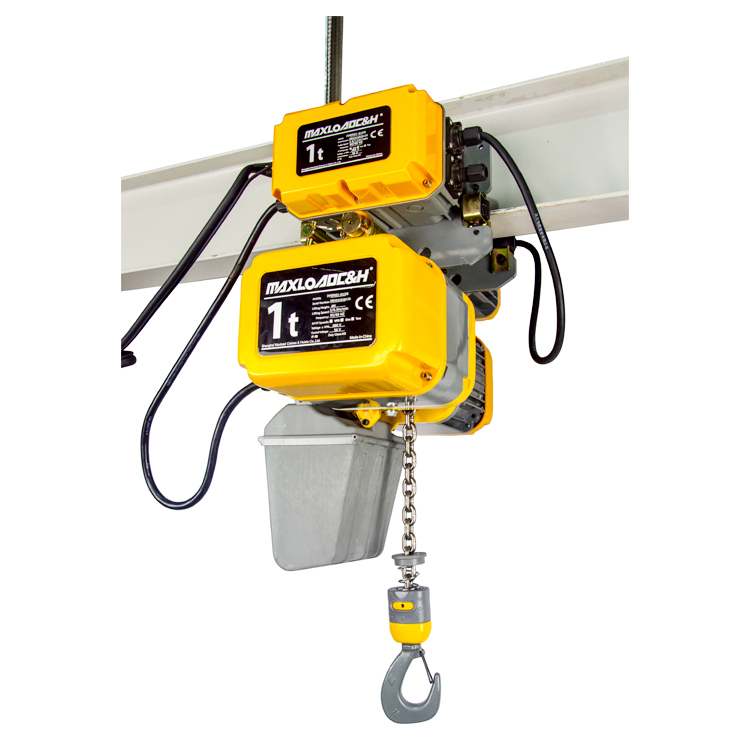
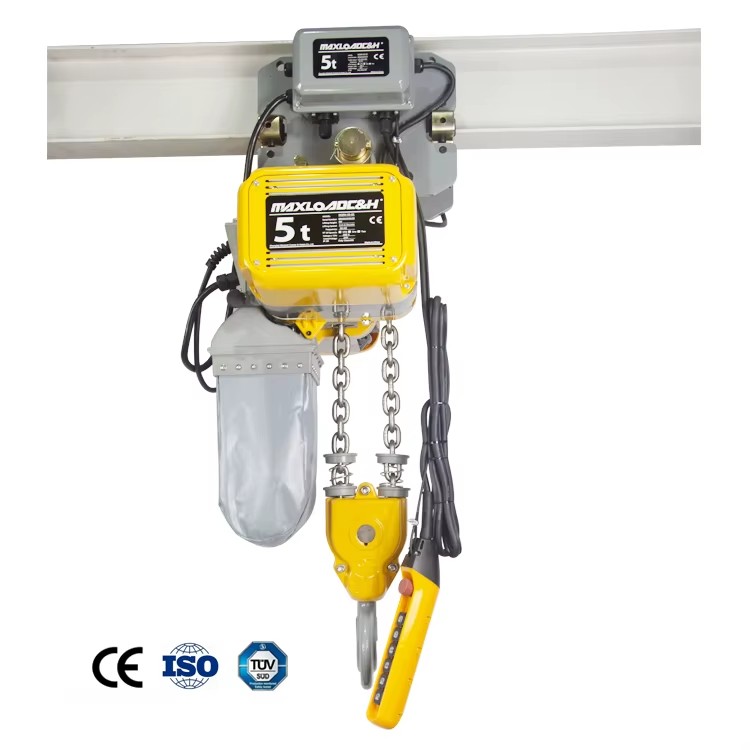
Coverage is another spatial parameter. If the workstation requires the hoist to move in a straight line along a track, a manual push trolley is the most economical choice; if movement is frequent and the load is relatively heavy, an electric trolley can reduce operator effort. For workstations that need to cover a certain area but are not suitable for installing an overhead crane, a chain hoist with a travel trolley combined with a monorail or jib system is a lighter-weight solution.
Work Cycle: If Single Speed Is Enough, Don't Spend Extra on Two Speed
The production rhythm of the workstation determines the hoist's speed configuration.
For occasional lifting in warehouses, low-frequency loading and unloading in maintenance rooms, and occasions that do not require positioning accuracy, a single-speed hoist is completely sufficient. Single-speed models have a simple structure, fewer failure points, lower maintenance costs, and a lower purchase price. But if the workstation has cycle requirements—for example, workpieces on an assembly line need precise alignment, frequent starts and stops are required, or the operator needs to observe while fine-tuning the position—then a two-speed configuration is worth the investment. The role of the slow speed is not "slowness," but making starts and stops smooth and avoiding workpiece collisions caused by hook sway.
For workstations with higher positioning accuracy requirements, variable-frequency-controlled two-speed or stepless speed regulation is a further choice. A variable-frequency drive gives both lifting and travel soft start and soft stop, significantly reducing hook swing. When aligning, the operator does not need to repeatedly "inch" to correct the position. The cost is a larger control box and higher cost, but in precision assembly or clean workshops, what this investment buys back is yield and operational safety.
Environmental Adaptation: When Standard Models Cannot Solve It, Configuration Must Be Selected
Environment is the most easily underestimated dimension in selection. With the same tonnage and speed, placed in different environments, service life may differ several times over.
In workshops that are humid, dusty, or contain corrosive gases, motors and brakes with ordinary protection ratings will age faster. The gap between protection ratings IP54 and IP66, in a food processing workshop that undergoes washdown cleaning or in a coastal factory area, is the difference between failure in a few months and no failure for several years. Dusty environments require attention to the sealing of electrical boxes, and corrosive environments require attention to the material and surface treatment of chains or wire ropes.
Explosive hazardous environments are a red line. In areas of the chemical, petrochemical, and pharmaceutical industries where flammable gases or dust may exist, sparks from ordinary hoist motors and friction from brakes may become ignition sources. The motors, brakes, and control boxes of explosion-proof hoists are specially designed and certified, and explosion-proof ratings correspond to different hazardous area classifications. During selection, it is necessary first to confirm which hazardous area classification the workstation belongs to, and then match the corresponding explosion-proof level. Outdoor open-air workstations also need to consider rain protection, rust prevention, and temperature range. The applicable temperature range of standard hoists is usually between - 20°C and +40°C. Extremely cold or high-temperature environments require special lubrication and sealing solutions.
Returning to the logic at the beginning: tonnage and height are the admission ticket. Load spectrum, space, cycle, and environment are the real variables that determine "how long this hoist can live at the workstation and whether it is easy to use." During selection, lay out the workstation's average daily number of cycles, actual clearance dimensions, operational positioning requirements, and air and environmental conditions, then compare them one by one against catalog parameters. This is far more reliable than simply asking, "How much for a three-ton one?"
 0086 156 1824 5535
 0086 156 1824 5535
 kimliu@chnhoist.com