Guide to adaptability selection for electric hoists
When purchasing an electric hoist, a common misconception is to look at the specification table first and then match the equipment to it. Rated lifting capacity, lifting height, power—these figures are certainly important, but what they answer is the question of "whether it can lift it." What truly determines whether a piece of equipment is easy to use, durable, and safe at a specific workstation are the adaptability factors beyond those numbers.
In other words, the same tonnage and height, placed on an assembly line versus placed in a pickling workshop, require completely different pieces of equipment. The following expands on several core dimensions of the workstation environment to sort out the judgment logic during selection.
I. Clearance conditions: measure the space first, then decide on the model
How much usable vertical space there is above the workstation is the first filter in selection. What is easily overlooked during renovation of old factories or planning of new production lines is that the structural height of the electric hoist itself will consume part of the lifting height.
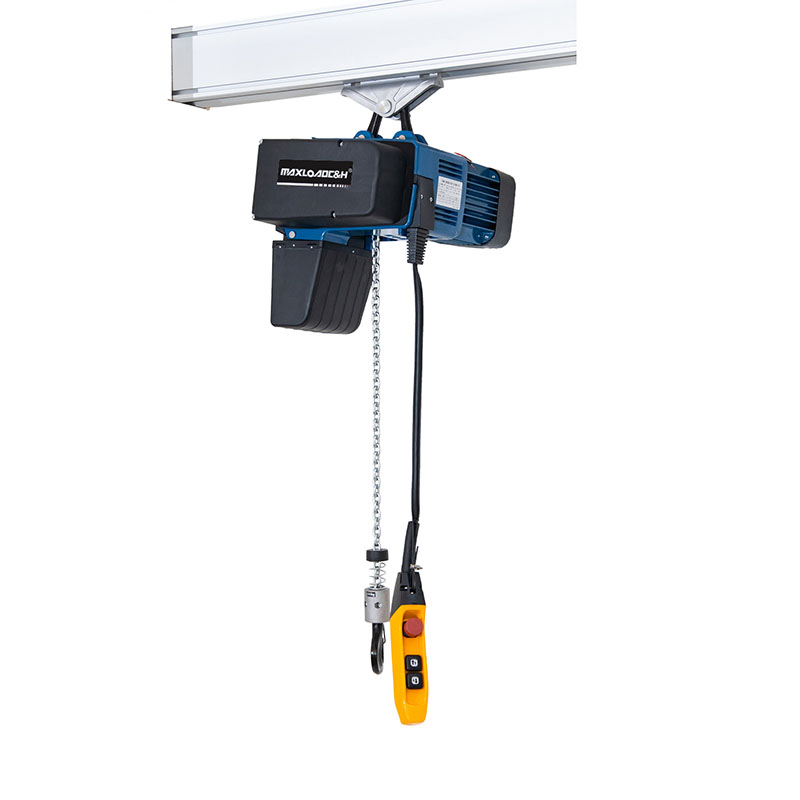
Wire rope electric hoists have a relatively large axial dimension for the drum, and the overall machine height is fairly considerable; chain electric hoists have a compact sprocket mechanism, and at the same tonnage the body is thinner. If the factory clearance is ample and the lifting stroke is long, wire rope models have more advantages in running stability and heat dissipation conditions. Conversely, if there are pipeline bridges, air-conditioning ducts above the workstation, or if it is itself a low workshop, the low-headroom characteristic of chain models becomes a hard requirement.
There is a detail that is easily overlooked here: the height of the I-beam track itself also needs to be deducted from the clearance. During selection, one should subtract "the distance from the lower chord of the factory beam to the ground" minus "the height of the hoist itself" and then minus "the minimum limit dimension of the hook block"; what remains is the effective lifting height.
II. Work pace and load spectrum: determines the duty class, not merely the tonnage
Leaving margin in tonnage selection is already common sense—for conventional working conditions, it is recommended to leave a 1.25 times safety factor on the basis of the maximum lifted load, and for high-frequency or vibrating working conditions, 1.5 times is recommended. But what truly distinguishes whether a piece of equipment can be used for three years or ten years is the duty class.
The duty class is determined by two variables: average daily operating time, and the distribution characteristics of the load. A piece of equipment that lifts a few times intermittently each day, each time close to full load, and a piece of equipment that lifts hundreds of times each day but with most loads only 30% of the rated value, even if the tonnage is the same, have completely different duty class requirements.
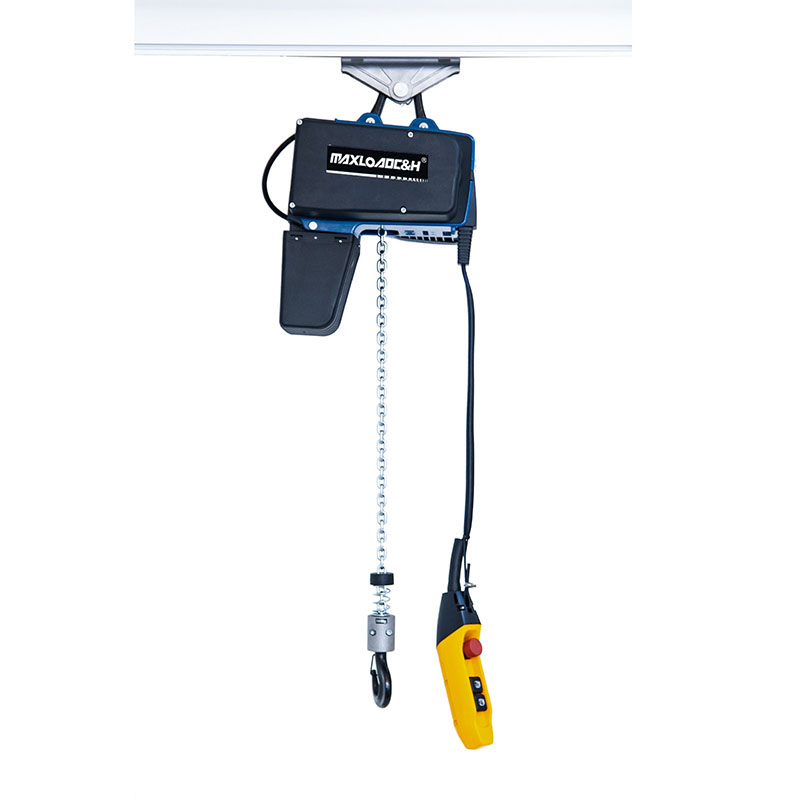
For intermittent operation at a warehouse or maintenance workstation, a single-speed model is sufficient, with a simple structure and few failure points. But if it is a loading and unloading workstation beside a production line, or an assembly link requiring frequent precise positioning, the value of dual-speed or variable-frequency speed regulation becomes apparent. The fine-tuning capability of the slow-speed gear when approaching the workpiece directly relates to the risk of collision and positioning efficiency. More critically, frequent starting and stopping impose a thermal load on the motor and brake far higher than continuous operation. If the duty class is selected too low, motor burnout or brake failure is only a matter of time.
III. Environmental media: the protection rating is not optional
What is in the workshop air determines what needs to wrap the outside of the hoist.
Dusty environments need to distinguish the nature of the dust. Ordinary grinding dust and combustible dust such as flour, aluminum powder, and coal powder are handled in completely different ways. The latter involves explosion-proof design, requiring all components that may generate arcs or high temperatures, such as motors, electrical control boxes, and buttons, to be enclosed in flameproof housings, and exposed parts also need spark-free treatment. This is not a problem that can be solved by adding a dust cover.
The erosion of metal structures in corrosive environments—such as electroplating, pickling, and fertilizer production—is continuous. Ordinary coatings may blister and peel within a few months, and then rust the wire rope and seize the wheels. Corrosion-resistant models require targeted replacements in surface treatment, sealing material, and even the material selection of the wire rope.
The core indicator for humid or outdoor environments is the protection rating. IP55 can handle splashing, and IP66 can withstand strong water jet washing or short-term immersion. If the workstation has the habit of regularly washing the floor, or if the hoist is installed under a semi-open rain shed, and the IP rating is selected too low, moisture intrusion into the motor and electrical control box is only a matter of time.
IV. Special logic for special workstations
The selection logic for cleanrooms is almost the opposite. Ordinary hoists require lubrication, and lubricating grease will volatilize; friction between wheels and tracks will generate particles; gaps in the shell will accumulate dust. What cleanroom workstations need are fully enclosed housings, low-volatility lubricating grease, non-metallic wheels or specially coated tracks, and a smooth, dead-corner-free shape design that can be wiped with alcohol. Here, "preventing contamination" is harder to achieve than "being able to lift."
In high-temperature environments, especially in metallurgical casting workstations lifting molten metal, selection has already gone beyond the scope of conventional industrial hoists. Such workstations require specialized safety designs: heat shields, high-temperature-resistant wire ropes, dual brakes, and a higher safety factor. Using an ordinary hoist above a molten steel ladle means the money saved on equipment is far from enough to cover the cost of one accident.
V. Matching of installation methods
Stationary electric hoists are suitable for workstations with a single lifting point and vertical lifting, such as equipment maintenance positions or beside small presses. Traveling electric hoists are used for workstations that need to move along a track. The matching of the trolley travel speed and the lifting speed is equally important—fast lifting with slow traversing, or the reverse, will make the operator feel awkward.
There is also a link that is easily overlooked: the selection of the I-beam track. The wheels of the hoist trolley are designed for a specific flange width. The thickness of the track flange, the width of the tread, and even the deflection of the track will all affect running stability and wheel life. It is not uncommon to confirm the hoist parameters and then stop, only to find during installation that the trolley gnaws the rail or jams.
The essence of selection is, on the basis of "being able to lift," answering the questions of "in what environment, at what frequency, lifting what, and for how long." Tonnage and height are the starting point, not the end point. Going through the workstation's clearance, pace, media, cleanliness, and installation conditions one by one is what truly gives meaning to those numbers on the specification table.
 0086 156 1824 5535
 0086 156 1824 5535
 kimliu@chnhoist.com