The Logic of Environment Adaptation in Electric Hoist Selection
When many people select an electric hoist, they habitually focus on tonnage and price first, asking "How much is a two-ton one?" before considering anything else. This order itself is wrong. Tonnage is only the entry ticket. What truly determines how long a hoist can be used, how well it performs, and whether it will cause an accident is the environment in which it is installed. Two units with the same lifting capacity—one placed in a dry assembly workshop and the other above an electroplating tank—may differ in service life by more than three times.
The underlying logic of electric hoist selection is to read the environment first, then define the parameters. The environment's requirements for the equipment are divided into several levels: spatial conditions determine the structural form, operating frequency determines the duty class and speed control method, and air composition determines the protection and explosion-proof rating. Proceeding layer by layer, only at the end does it come down to specific specifications.
Look at the Ceiling First, Then Talk About Tonnage
How much usable space there is above the workstation is the first hard constraint in selection. The fundamental structural difference between wire rope hoists and chain hoists directly determines that their spatial requirements are completely different.
The drum of a wire rope hoist is arranged axially, making the overall body relatively long, and the minimum distance between the hook and the rail is relatively large. If the factory has ample clear height, this is not a problem; but if it is a renovation of an old factory building, or if pipelines are densely packed above the workstation and ventilation ducts pass through, after a conventional wire rope hoist is installed, the hook may already be close to the ground, leaving very little effective lifting height. In this case, a low-headroom structure must be considered, with the drum mounted on the side or a parallel-shaft arrangement used to compress the body height.
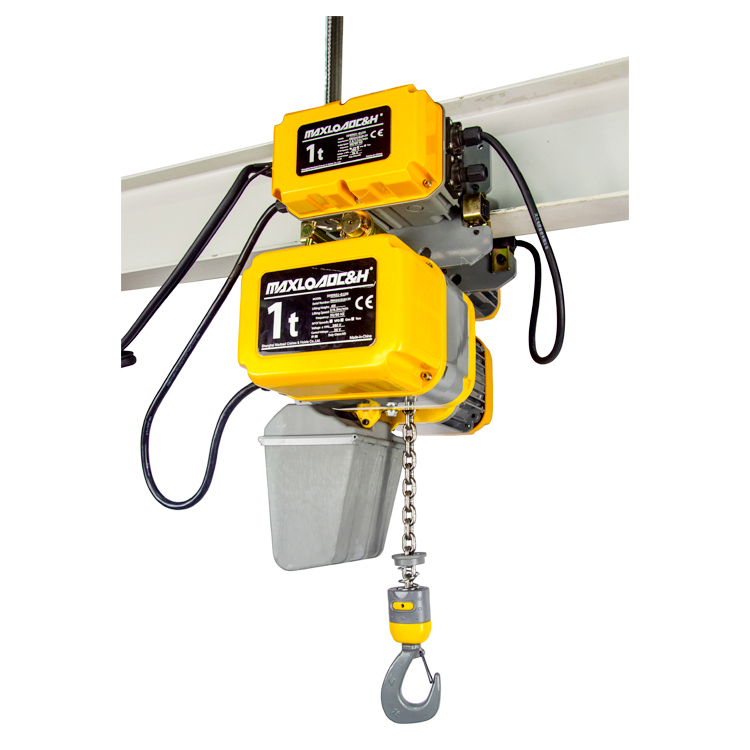
The situation for chain hoists is the opposite. The chain replaces the drum, making the body shorter and more compact, and its own weight is much lighter. At the same tonnage, the vertical space it occupies is significantly smaller. For low workshops, temporary workstations, or occasions where lifting must be completed in narrow areas, chain hoists are often the more practical choice. The trade-off is that the lifting height is usually limited, conventionally within twelve meters, and anything higher requires customization, whereas wire rope hoists commonly handle over thirty meters.
In one sentence: when height is ample, choose wire rope; when space is tight, prioritize chain hoists and low-headroom structures.
Operating Frequency Determines the "Skeleton," Not the "Shell"
The most easily underestimated factor in the workstation environment is the operating pace. A hoist that lifts three to five times a day and a hoist that completes one cycle every two minutes on an assembly line may both look like "electric hoists," but the design margins of their internal mechanisms and motors are completely different species.
The industry uses duty class to quantify this. FEM/ISO standards grade hoist duty classes from M3 to M6 step by step, corresponding to multiplied differences in theoretical full-load operating hours. M3 is suitable for maintenance workstations or warehouse corners where lifting is occasional, while M5 and above are suitable for production line workstations where there are hundreds of cycles per day.
This parameter is not reflected in appearance, yet it is the core factor determining the actual service life of the equipment. Using an M3 hoist to do M5 work may not show problems in the short term, but motor temperature rise, brake wear, and gear fatigue will all accelerate, and the failure rate will clearly climb after half a year.
Paired with duty class is the speed control method. For intermittent operation, a single-speed model is sufficient, with a simple structure and few failure points. But for precision assembly, mold alignment, or occasions where the workpiece must not sway, dual-speed or variable-frequency control is almost mandatory. The slow speed is not for "slowness"; it is to make the hook obedient in the last few centimeters of travel, avoiding repeated impacts and swinging. Variable-frequency control can further reduce start-stop impact, which is friendlier to both the hoist structure itself and the factory steel structure.
What Is in the Air Matters More Than What Is on the Ground
The real test of the environment for an electric hoist is not what is being lifted, but what is suspended in the air.
A conventional dry workshop is the least troublesome scenario. There are no corrosive media, dust concentration is low, humidity is within the normal range, and a hoist with a standard protection rating can handle it. In this case, spending money on duty class and speed control is more valuable than spending it on special protection.
Humid and corrosive environments are on another level. In electroplating workshops, pickling workstations, seaside factories, and sewage treatment areas, corrosive media filling the air will continuously attack wire ropes, chains, hooks, and electrical enclosures. Ordinary paint coatings cannot last long in such environments, and adjustments must be made at the material level—choosing corrosion-resistant treatment for chains or wire ropes, using a higher-grade coating system for structural parts, and considering stainless steel components in severe cases. Salt spray environments are especially harsh; ordinary carbon steel parts rust much faster in coastal factories than inland.
The threat of high-dust workstations is not "dirt," but the abrasive wear formed after dust enters the motor and gearbox. In scenarios such as cement plants, foundries, and flour processing, dust penetrates everywhere. If the sealing grade of the electrical box is insufficient, dust accumulation on contacts will cause poor contact, and after the brake gap is filled with dust, braking force will gradually decline. Such working conditions require attention to the protection rating. IP55 is the baseline, and for high-dust occasions, models with tighter sealing structures should be selected.
Flammable and explosive environments are a red line, with no room for discussion. In areas such as chemical workshops, paint workstations, pharmaceutical workshops, and flour storage where combustible gas or dust exists, motor sparks from an ordinary hoist, brake friction, or even impact between the hook and the workpiece can become an ignition source. The core difference of an explosion-proof hoist is that the motor, electrical box, and control handle all adopt a flameproof design, the hook contact part uses copper or stainless steel material to avoid friction sparks, and the circuit undergoes current-limiting treatment. During selection, the corresponding explosion-proof rating must be matched according to the type of hazardous medium on site and the area classification. Gas environments and dust environments require different protection directions and cannot be mixed.
An electric hoist usually stays at a workstation for more than five years. Deviations in environment adaptation will not be exposed immediately, but will slowly accumulate in every cycle. Spending an extra half day clarifying the environmental conditions during selection is far more cost-effective than replacing or modifying later.
 0086 156 1824 5535
 0086 156 1824 5535