The Working-Condition Logic of Electric Hoist Selection
When many people select an electric hoist, they are used to starting with the product catalog, first looking at what models and parameters are available, and then finding one that is "roughly usable." This approach is not wrong, but the order is reversed. A more reasonable approach is the opposite: first understand clearly what the workstation itself "requires," and then match the equipment. The workstation environment determines what capabilities the hoist needs, rather than making the equipment accommodate the environment.
First Look at Tonnage: It Is Not Simply "Choose the Size Based on How Heavy the Load Is"
Rated lifting capacity is the most basic parameter, but it is also the one most easily oversimplified. In actual selection, what really needs to be determined is not "how heavy the maximum lifted object is," but "what the heaviest load that may appear at this workstation is, and at what frequency it appears."
A common practice is to leave a safety margin of 20% to 30% on top of the actual maximum lifting weight. For example, if the largest daily lifted item is 2 tons, then a rated lifting capacity of 2.5 tons or 3 tons is a more reliable choice. The margin is not waste; it leaves room for load fluctuations, cargo swaying, and start-stop impact. A configuration that just sits at the critical value can operate in the short term, but over the long term it will accelerate equipment wear and also plant hidden safety hazards.
However, tonnage alone is not enough. The same hoist with a rated capacity of 5 tons, if it only lifts two or three times a day and each time is close to full load, versus lifting dozens of times a day but mostly only one or two tons, will bear completely different actual "pressure." This leads to the next, more critical dimension: working class.
Working Class: Determines "How Much Work" the Hoist Is Suitable For
Working class is the most specialized and also the most easily overlooked part of electric hoist selection. In plain terms, it answers the question: how intense a work rhythm is this equipment designed to withstand?
According to common FEM or ISO classification systems, working classes can roughly correspond to actual scenarios as follows: Class M3 is suitable for light-load occasions with intermittent use of less than two hours per day, such as warehouses or maintenance workstations with occasional lifting; M4 corresponds to conventional intermittent operations of two to four hours per day, and is a common choice for daily workshop handling; M5 is aimed at high-frequency working conditions with four to eight hours per day and relatively large load fluctuations, such as fixed lifting workstations on assembly lines.
A misunderstanding easily arises here: some people think that the higher the class, the better, and that choosing M5 or even M6 directly will never be wrong. But the working class reflects the equipment's designed service life. A higher class means that, under the same load spectrum, it can withstand more total working cycles, and it also means higher procurement cost and a heavier structure. If the workstation itself is used only one or two hours a day and lifts only light loads, yet an M5 configuration is chosen, the extra capability cannot be used, while the investment is not reduced. Conversely, if a workstation operates continuously every day with frequent lifting, but M3 is chosen to save money, the equipment will experience problems such as motor overheating and brake wear in a time far shorter than expected, and in the end it will be the entire production line that stops.
When judging the working class, there is a simple method: count "how many actual lifting operations this workstation performs each day, roughly how heavy the object is each time, and how high the proportion of operations close to rated load is." Giving this information to technical personnel is much more useful than merely reporting "I want a certain tonnage."
Lifting Height and Headroom: How Much "Margin" the Workstation Leaves for the Hoist
Lifting height and headroom conditions are the most intuitive constraints in the workstation environment. Lifting height refers to the vertical distance from the lowest working position of the hook to the highest position. During selection, a certain safety distance must be reserved above "the highest point to which the cargo needs to be lifted" to prevent over-travel and collision with the top.
More noteworthy is the headroom limitation. The space above many workstations is not generous - factory building height is limited, the distance from below the I-beam track to the ground is tight, or there are pipelines or structures obstructing the path above the lifting route. In such cases, the body height of a conventional hoist may make it impossible for the hook to reach the ideal lowest position. Low-headroom hoists are designed precisely for such workstations. Their structure is more compact, and under the same track height they can lower the hook further, or under the same lifting height they occupy less vertical space.
During selection, one should not only focus on "what lifting height I need," but also look at "how much vertical space the workstation allows the hoist to occupy." The relationship between these two figures often determines whether you need a standard model or a low-headroom model.
Fixed Type or Traveling Type: Determined by the Workstation's Handling Logic
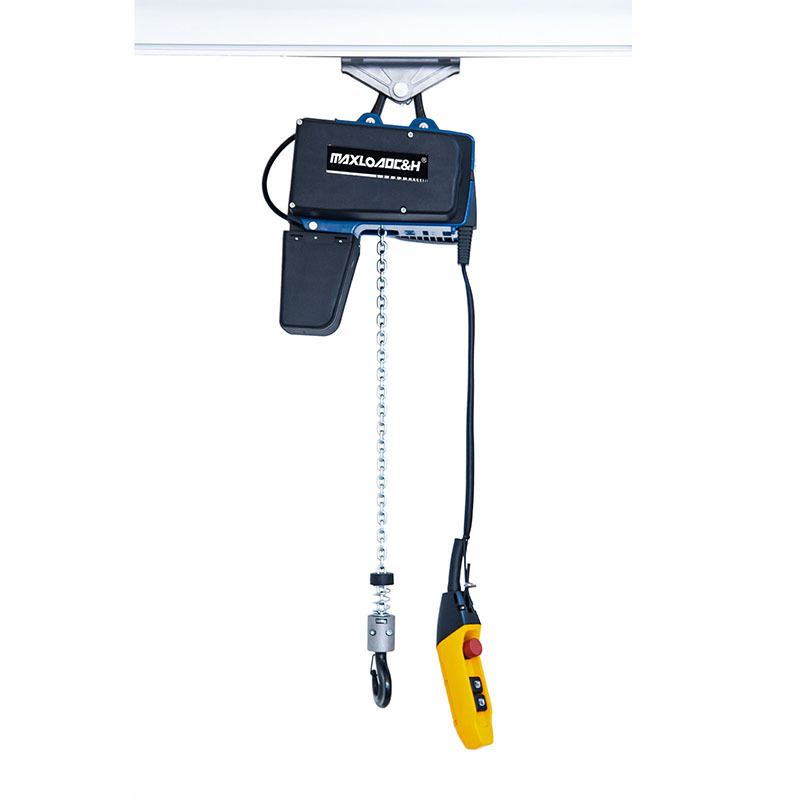
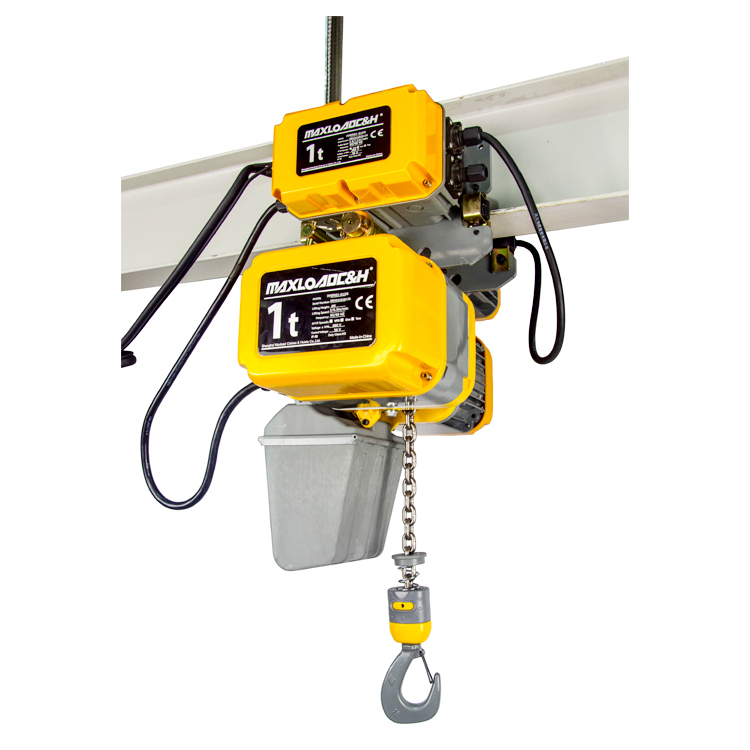
Electric hoists have two basic installation methods: fixed type and traveling type. The fixed type can only lift up and down at one fixed suspension point and is suitable for scenarios where "lifting the cargo" is enough and horizontal movement is not needed; the traveling type is equipped with a trolley and can move left and right on an I-beam track, and is suitable for workstations that need to move cargo from one position to another.
This choice is essentially not an equipment issue, but a logistics issue of the workstation. If an assembly workstation only needs to lift parts from the ground to the tabletop, the fixed type is fully sufficient, with a simpler structure and lower cost. If the workstation involves material transfer across areas, such as lifting from a temporary storage area to a processing area, the traveling type is necessary. The traveling type is also divided into manual and electric trolleys. Manual ones require people to pull and drag them, while electric ones can be operated by remote control. Their efficiency and convenience differ, and the corresponding investment also differs.
Environmental Particularities: What the Workstation Is "Reminding" You to Pay Attention To
The previous dimensions are general logic, but some workstations put forward special requirements, and placing an ordinary hoist directly into them will cause problems.
Dusty and corrosive environments. In foundry workshops, chemical workshops, and near electroplating or pickling workstations, the air may be filled with conductive dust, corrosive gases, or acid-base mist. The motors and electrical components of ordinary hoists will age faster in such environments, and brakes may fail due to dust accumulation. Such workstations require hoists with higher protection ratings, and the outer shell and internal electrical parts must have targeted sealing or anti-corrosion treatment.
High temperature and molten metal. Metallurgical and foundry workstations lift high-temperature workpieces or even molten metal, and thermal radiation will cause continuous damage to the hoist's motor, brake, and wire rope. Such occasions require special high-temperature-resistant designs, such as adding heat insulation plates at key positions or adopting dual braking systems to ensure braking reliability under high-temperature environments.
Explosion-proof areas. Some workstations in industries such as petroleum, chemicals, and pharmaceuticals may contain flammable and explosive gases or dust. The motor of an ordinary hoist may produce electric sparks during operation, and friction in the brake may also generate high temperatures. These all constitute ignition sources. Explosion-proof workstations must use equipment with special explosion-proof certification, and the corresponding explosion-proof level must be selected according to the area classification.
Clean environments. In clean workshops in fields such as electronics manufacturing, pharmaceuticals, and food processing, the concern is the opposite: the hoist "contaminating the environment." Lubricant volatilization from ordinary hoists, particles produced by friction of metal parts, and even dust accumulation on the outer shell may all become pollution sources in a cleanroom. Such workstations require cleanroom-specific designs: fully enclosed structures, low-volatility grease, stainless steel or specially coated outer shells, and easy-to-clean surface treatment.
The logic for judging environmental particularities is very simple: if the air at the workstation contains something that an ordinary hoist "fears," or the workstation environment "fears" what an ordinary hoist brings, then it is necessary to step outside standard models and consider special configurations.
In summary, when facing a specific workstation, requirements can be sorted out in the following order:
First confirm what the workstation "allows" - how much headroom there is, what the track conditions are, and whether there are special environmental restrictions. Then confirm what the workstation "needs" - what is lifted, how heavy it is, how frequently it is lifted, and whether horizontal movement is required. Finally comes "what to choose" - based on the conclusions of the previous two steps, match the rated lifting capacity, working class, lifting height, installation method, and protection rating.
The significance of this order lies in the fact that workstation conditions are usually rigid and will not change because a certain piece of equipment is selected, while equipment selection has room for adjustment. First, understand the boundaries clearly, then find the optimal solution within the boundaries. This is far more reliable than first selecting equipment and then trying to find ways to make it "adapt" to the workstation.
 0086 156 1824 5535
 0086 156 1824 5535