Choosing an Electric Hoist: Start with the Workstation, Then the Tonnage
When a customer calls about an electric hoist, nine times out of ten they open with the tonnage: "What's the price on a 3-ton one?"
My usual response is to ask back: "What's your workstation situation like?" I'm not being difficult. Every configuration that follows — what size motor, what protection rating, fixed suspension vs. trolley-mounted, whether you need variable frequency — is almost entirely determined by the workstation environment. The rated load is only half the selection equation. Many people treat it as the whole thing, and end up with a hoist that either won't fit or won't last.
Tonnage Is Step One — Don't Let It Be the Only Step
Let's start with the basics: the rated load.
But "3 tons" needs to be broken down. Are you occasionally lifting a 3-ton piece of equipment for maintenance, or are you running a production line where 3-ton workpieces are being lifted nonstop all day? These two scenarios demand completely different hoist specifications.
In this industry, whether a hoist holds up isn't just about tonnage — it's about duty cycle, which boils down to "load spectrum × daily operating hours." The same 3-ton hoist, used occasionally versus running 8-hour continuous cycles, calls for entirely different motors, gearboxes, and brakes. The price difference can be nearly double. If you spec it for light-duty maintenance and then run it around the clock, the motor will overheat and the brake will slip before long. Conversely, over-specifying for high frequency when you only need it occasionally is just throwing money away.
So before you buy, pin down two things: the weight of the heaviest load you'll ever lift, and how many times per day the hoist will actually run, and for how many minutes each cycle. This data is worth more than the tonnage number itself.
If There's No Headroom, No Hoist — No Matter How Expensive — Will Work
The clearance above the workstation is often overlooked, yet it's the make-or-break factor for installation.
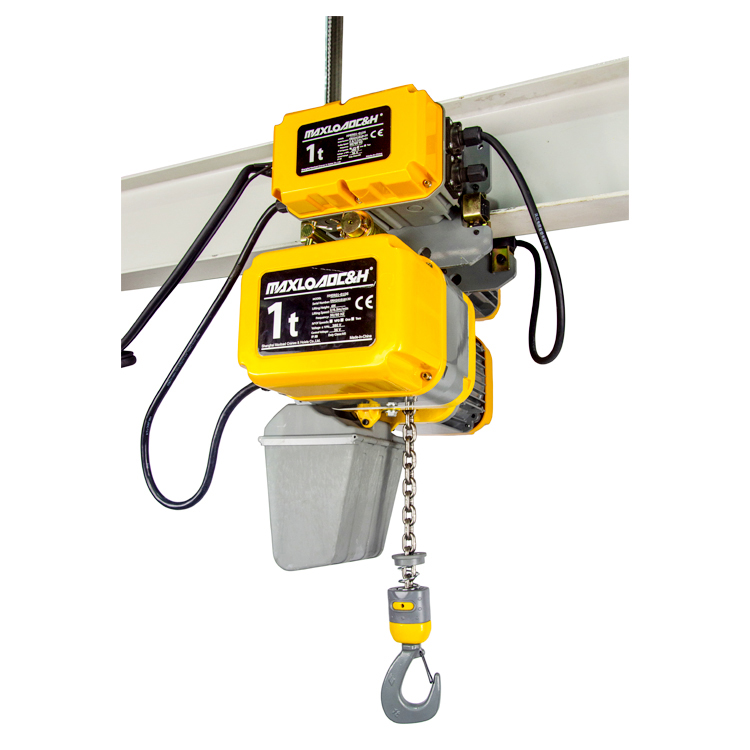
Take chain electric hoists, for example: the fixed-hook version and the trolley-mounted version occupy different amounts of overhead space. Some factories have low eaves with only a sliver of height available above — in those cases you need a European-style low-headroom hoist; otherwise the motor and chain housing will hit the roof beam and the trolley won't fit through.
Don't just report "workshop height" for lift height either. The truly usable height is calculated as: the lower chord of the runway beam minus the sling/attachment length minus the height the load needs to clear — the remainder is your actual travel. Plenty of orders have gone wrong this way: the shop looks tall enough, but once you run the numbers, you realize even the shortest workpiece won't clear.
Measure these five numbers before you even talk pricing: eave height, lower chord height, maximum workpiece height, sling length, and the farthest/highest point the load needs to reach. Get these right and you're halfway home.
Coverage Area Dictates the Hoist Type
This point is determined directly by the workstation shape and working radius, and it's the most frequently skipped step in selection.
If you're only lifting at a single fixed point → a fixed-hook hoist is enough.
If you need to move along a line back and forth → you need a traveling hoist with a trolley running on a rail.
If the work falls within a fan-shaped radius around a single station → a jib crane or articulating jib crane paired with a hoist is the more economical choice — no need to run an entire overhead rail.
If you need to cover an area and serve multiple workstations shared by one system → then consider a single-girder crane or light modular suspension system.
Here's a common mismatch: a three-meter-square workstation, yet someone insists on running dozens of meters of runway rail. Or the reverse — they need to span multiple stations but buy a fixed-hook unit that can only lift in place. The rule of thumb is simple: sketch out where all your lifting points land. Are they points, a line, or an area? Then decide how to pair the hoist with the rail.
Also worth noting: the runway isn't an accessory to the hoist. For light-load, high-frequency assembly work, a modular light-rail system is sufficient, lightweight, and easy to reconfigure later. For heavy loads or frequent lifting, you need I-beam or European-style single-girder construction — and the rail's load capacity must be calculated together with the columns and roof structure. Looking only at hoist tonnage without checking whether the overhead rail can support it is a recipe for trouble.
Voltage and Environment — the Two Places with the Highest Error Rate
These two sound trivial, but when field failures happen, this is where they're usually rooted.
Voltage first. Many sites run 380V/50Hz/three-phase, but there are also single-phase supplies and other voltage classes. If the voltage doesn't match, the whole unit goes down, and reworking on site is the most time-consuming problem of all. Before ordering, write down the site's voltage, frequency, and phase configuration in one shot.
Environment is even easier to underestimate. In a heavy-dust workshop, the protection rating has to be high enough — a standard-protection motor will burn out quickly once dust gets in. For damp environments or outdoor use, moisture and rain protection must be factored in. Cleanroom facilities can't use standard lubricants or oil-containing components — you need dust-proof, oil-free, special-lubrication configurations. Extremely high or low temperatures mean greases in the motor and gearbox need to be switched to different grades. And then there are hazardous/explosive areas — no compromise here. You must select by explosion-proof rating. You can't cut corners, and you can't pass off a standard hoist as certified.
One more thing most customers overlook: dual limit switches. One electrical limit and one mechanical limit — two layers of protection against over-travel that could damage equipment or snap the chain. This is not a place to save money.
The approach is: first classify the site — clean workshop, dusty plant, humid environment, cleanroom, or explosive atmosphere — then talk configuration. Many "why does this hoist keep breaking" cases turn out to be wrong protection ratings all along.
Speed and Control — Match the Job and the Operator, Don't Over-Configure
On speed, the biggest mistake is jumping straight to variable frequency.
For ordinary handling, two-speed is plenty, and the starts and stops are smooth. The value of a VFD (variable frequency drive) is in precise positioning — when you're lifting fragile or expensive workpieces that need to land with exact accuracy, or when micro-speed lifting is required, that's where VFD earns its keep. Specifying VFD on a routine handling application just because it "sounds premium" wastes money, and VFDs also raise the on-site maintenance bar and failure rate. Not worth it.
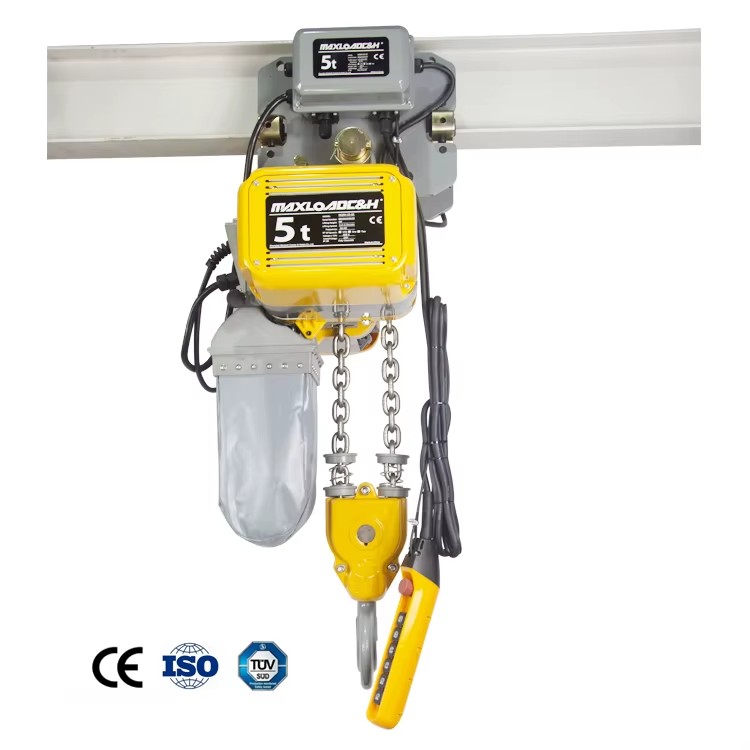
Same logic for control method: follow operator habit. A pendant pushbutton is simple, intuitive, and low-cost. Radio remote control lets the operator walk with the load and avoid blind spots — better sightlines and better positioning. For large workstations, tall lifts, or jobs where the operator needs to follow the load, remote control is the better fit. An emergency stop button is mandatory — that's the baseline, no exceptions.
Closing
So, if you're outfitting a workstation with an electric hoist, the easiest approach isn't to call with a tonnage and wait for a quote. Give the supplier your actual working conditions, and they'll spec the hoist around your duty cycle — not just pad it around a tonnage number. The quote will be accurate, the lead time will be smooth, and the unit won't fail on site. After all these years in the trade, this is what I most want to align with customers up front.
 0086 156 1824 5535
 0086 156 1824 5535