Deriving Equipment Parameters from Working Conditions
Selection mistakes with electric hoists are rarely because someone "doesn't know what tonnage to buy." More often, it's because they use office thinking to guess at what's happening on the workshop floor. A procurement person sits at a computer, takes the maximum workpiece weight, and asks for a quote. The manufacturer asks, "What's the environment like? How many lifts per day? How tall is the factory building?" The answers are often, "Just an ordinary workshop," "Not many times a day," and "About four or five meters, I guess." With vague information, the manufacturer quotes the most conventional configuration. By the time the goods arrive on site, problems surface: a standard motor was used in a dusty environment, corrosion is severe in a humid workshop, the hook nearly touches the ground after installation in a low-clearance building, and a single-speed hoist was chosen for a high-frequency workstation where every positioning move requires three seconds of back-and-forth swaying.
The essence of selection is not choosing a "good piece of equipment," but choosing equipment that matches the constraints of the workstation environment. The workstation environment determines which parameters are rigid and which you can compromise. The following breaks down how the workstation environment drives selection backward, in the actual order of decision-making.
Clearance Conditions Determine the Model Route
Vertical space at the workstation is the first hard constraint, and it is often underestimated. In many old factory buildings, renovated workshops, or workstations with added ceiling pipelines, the available space at the top is far more limited than one might imagine.
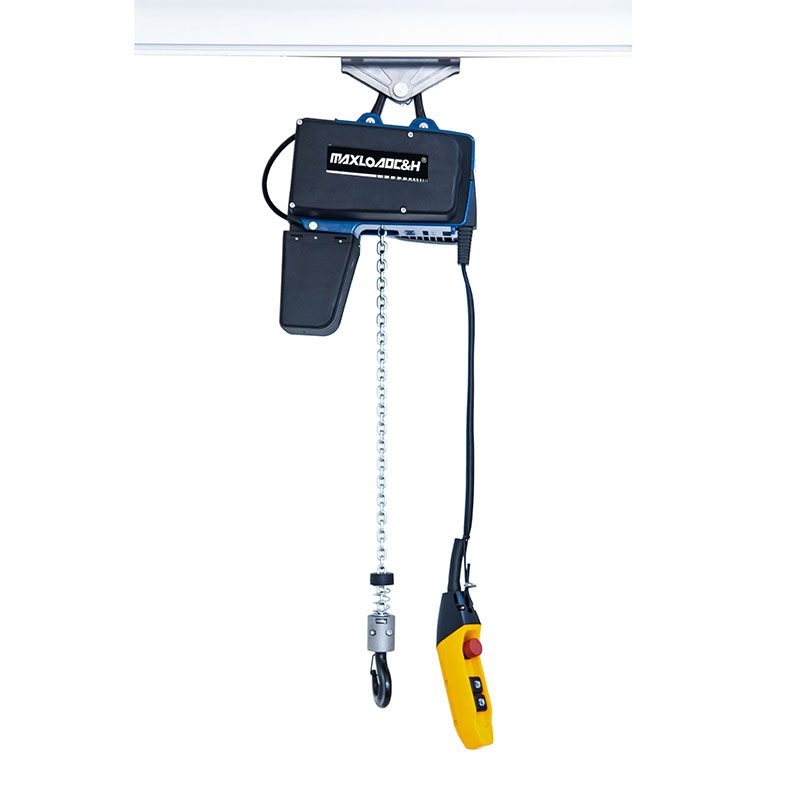
Conventional wire rope electric hoists have a relatively large body height. In workshops with sufficient floor height, they run smoothly, provide ample lifting height, and are the preferred route. But if the space above the workstation is restricted—for example, in an old factory renovation, where ventilation ducts have been added below the ceiling, or where the equipment installation position itself is under a mezzanine—a wire rope hoist may simply not fit. In such cases, the advantage of the chain electric hoist becomes apparent: a thinner body and more compact structure can squeeze usable lifting height out of limited vertical space.
There is a calculation that is easy to overlook: lifting height does not equal building height minus hoist height. The hook itself, rigging, workpiece height, and 1 to 2 meters of safety margin all have to be deducted from the clear space. If the workpiece needs to be placed inside equipment or passed through an opening for assembly, the precision requirement for the lifting stroke will be much higher than for simple transport. A low-clearance chain hoist paired with two-speed or variable-frequency control will be a more practical choice.
Working Frequency and Load Spectrum Determine the Duty Class
What best reflects the word "environment" in a workstation environment is actually the rhythm of human-machine interaction. A hoist in the corner of a warehouse that occasionally lifts spare parts and a hoist on an assembly line that lifts once every two minutes face completely different working intensities, even though their rated capacities may be the same.
Duty class is the indicator used to describe this intensity. M3 is suitable for intermittent light loads with less than two hours of operation per day, M4 corresponds to routine daily transport in ordinary workshops, M5 is used for assembly lines or high-frequency lifting, and M6 is for continuous heavy-duty working conditions. If selected too low, the motor and brake will overheat in the short term and wear will accelerate; if selected too high, procurement costs rise, but the equipment may not be cost-effective because it "never gets full" under low loads over the long term.
Judging duty class cannot rely only on "how many hours it runs per day"; the load spectrum must also be considered. If a hoist nominally rated at 10 tons spends 90% of its time at the workstation lifting only 2 to 3 tons and only occasionally approaches 10 tons, its actual load is far lower than that of a similar device that lifts 8 to 10 tons over the long term. Sorting out three sets of data clearly—typical workpiece weight, number of lifts per day, and the proportion of near-full-load lifts—is far more useful than simply reporting a maximum tonnage.
In addition, the tonnage selection itself should leave margin. The practice of choosing the corresponding tonnage exactly according to the maximum lifting weight has hidden risks: the impact at the moment of lifting, the dead weight of the rigging, and braking slippage after long-term use can all push the actual load beyond the rated value. For conventional working conditions, leaving a 1.25x margin is a relatively safe practice.
Lifting Speed Must Match the Workstation Cycle Time
Speed selection is easily simplified into "faster is better" or "slower is more stable," but what the workstation environment really needs is speed that matches the cycle time.
Single-speed hoists are suitable for low-frequency occasions with low positioning accuracy requirements—warehouse loading and unloading, occasional equipment maintenance—where lifting into place is enough and fine adjustment is not needed. But for assembly line workstations, precision assembly, or operations that require aligning a workpiece with a fixture or hole, the swaying and impact caused by single-speed lifting translate directly into operational difficulty and collision risk. The slow speed of a two-speed hoist makes inching positioning controllable, making fine adjustment during lifting and lowering possible.
If the workstation has higher requirements for lifting smoothness—for example, handling precision workpieces, fragile goods, or scenarios that require maintaining a stable posture during lifting—variable-frequency control is a further option. Stepless speed regulation can soften the acceleration during start and stop, reduce workpiece sway, and at the same time avoid wear caused by frequent brake action.
Environmental Media Determine Protection Configuration
This is the stage in selection where it is easiest to "save a little money and lose a lot." The protection rating of standard electric hoists is usually between IP44 and IP55, suitable for dry, clean indoor environments. But many workstations are not "ordinary."
Dusty environments: foundry workshops, grinding stations, powder feeding areas. Dust intrusion into the motor accelerates insulation aging, and intrusion into the brake affects braking performance. The protection rating needs to be raised to IP54 or IP64 or above, and the sealing of the motor and electrical components is key.
Humid or water-splash environments: washing stations, food processing areas, outdoor semi-sheltered workstations. When humidity remains above 85% for long periods or water splashing is present, the protection rating should be at least IP55; outdoor or frequently washed scenarios may require IP66. Humid environments also have a hidden cost: chains or wire ropes corrode much faster than expected. Chain hoist chains require more frequent lubrication and maintenance, while wire ropes require attention to broken wires and wear.
Corrosive media: electroplating, pickling, and the surroundings of chemical workshops. Ordinary coatings and galvanized chains have limited service life in these environments, and targeted anti-corrosion treatment is required, including confirmation of housing coatings, chain materials, and hook surface treatment.
Explosion-proof areas: if the workstation is in an explosive gas or dust environment, explosion-proof certification is mandatory, not optional. Explosion-proof hoists have special requirements for electrical boxes, motors, and hook materials, and cannot be replaced by ordinary equipment.
Power Supply Conditions Constrain the Feasibility of the Plan
Whether the workstation has three-phase power is often mentioned only late in the selection process, but it is actually a front-end constraint.
380V three-phase power is the standard for industrial electric hoists, with ample power and stable operation, suitable for workstations above one ton with continuous operation needs. But if the workstation is in an area without three-phase power—such as a small warehouse, a temporary construction site, or scattered maintenance points—then only a 220V single-phase hoist can be considered. Single-phase equipment has limited power and continuous working capability, making it more suitable for light-load, intermittent lifting. It cannot be expected to run stably at a high-frequency workstation.
Installation and Operation Methods Match the Spatial Layout
The same hoist, whether in fixed installation or traveling installation, corresponds to completely different workstation logic.
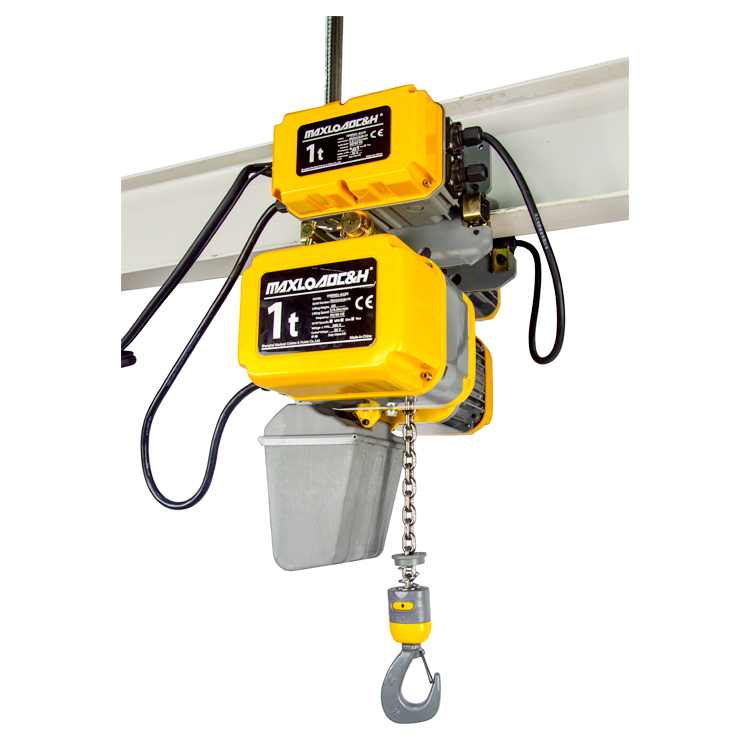
A fixed electric hoist can only perform vertical lifting at one suspension point, suitable for scenarios where the workpiece moves only up and down at a fixed position—for example, feeding material into equipment or picking and placing heavy objects from a rack. If the workpiece needs to be transferred horizontally between multiple workstations, a traveling hoist with an I-beam track is required, or it must be installed on a jib crane or single-girder crane.
The operation method is also worth choosing according to the workstation environment. Pendant control is the most common, with the operator following the load as it moves. But if the workstation space is narrow, if there is a collision risk when the operator follows the movement, or if the operator needs to stand in a safer position to observe the entire lifting process, non-following control or remote control operation can be considered.
A Few Practical Reminders for Implementation
Selection parameters ultimately have to land on the procurement list. Several points are easy to skip but costly afterward:
Confirm the load-bearing capacity of the installation surface. The hoist's own weight plus the rated load, as well as the lifting impact coefficient, all act on the installation structure. The specifications of the I-beam, the grade of the fixing bolts, and the strength of the supporting structure need to be calculated together with the hoist parameters.
Allow for maintenance accessibility. Hoists in dusty environments need regular cleaning, chains need lubrication, and brakes need inspection. If the installation position makes these maintenance actions extremely difficult, the maintenance cycle will be forced to lengthen, and the failure rate will rise accordingly. During selection, take a look at the same time: where can someone stand to reach the brake and the chain lubrication points?
Do not confuse duty class with tonnage. Using a lower tonnage does not improve the duty class. A hoist designed for M4, even if it lifts only 60% of its rated load, will still have its service life limited by its design duty class under high-frequency working conditions.
The workstation environment is the primary source of information for selection, more real than any product manual. Once clearance, frequency, environmental media, power supply, and operating flow are clearly understood, selection changes from an act of "guessing based on experience" into a derivation problem with constraints.
 0086 156 1824 5535
 0086 156 1824 5535