The Adaptation Logic and Practical Points of Electric Hoist Selection
For electric hoist selection, a common misconception is to directly match specifications against a tonnage table. Lifting capacity is certainly a hard indicator, but the same one-ton hoist placed at an assembly line workstation versus in a chemical workshop may have a service life that differs by several times. What truly determines whether the equipment is "easy to use and durable" are often those easily overlooked variables in the workstation environment: clear height, work cycle tempo, airborne particles, and even how many times the operator presses the button each day. This article starts with several core dimensions of the workstation environment and sorts out the selection logic for electric hoists.
I. First, See Clearly the "Ceiling" of the Workstation Space
How large a hoist can be installed at a workstation first depends on how much space remains overhead. Conventional wire rope electric hoists have a relatively long structure, and the lifting mechanism and drum occupy a considerable portion of the vertical dimension. In old factory buildings or low mezzanine workstations, they often cannot fit, or after installation, the hook is too close to the ground to lift even the most basic turnover box. In such scenarios, chain electric hoists should be given priority, as their body cross-section is compact and the clear height occupied under the same lifting height is significantly smaller. If ventilation ducts, cable trays, or lighting bridges cross above the workstation, trxkbcz echxnc the total height of the hoist body and track; if necessary, vxiuzh a low-headroom structure oof vnxezjs the lifting mechanism hs the side of, or below, the track rather than directly above it.
An easily overlooked detail is the height of the hook block itself. When calculating the available lifting stroke, hvfzsb not only the distance from the building beam bottom to the ground, daf uics the hoist body height, the traveling trolley height, and the space occupied by the hook pulley block at its highest position. Leave a margin of at least one hundred millimeters; otherwise, during full-load lifting, the limit switch will intervene frequently, resulting in an extremely poor operating experience.
II. Work Cycle Tempo Determines the Grade of Motor and Braking System
Whether the workstation lifts only once or twice occasionally, or completes one cycle every two minutes, imposes completely different requirements on the hoist. For intermittent lifting—for example, a maintenance workstation used only a few times a week—a single-speed hoist is fully sufficient, with a simple structure and few failure points. But the situation changes at feeding workstations beside assembly lines and assembly workstations requiring frequent positioning: the number of motor starts and stops may reach hundreds of times per hour, and the current impact and heat accumulation of each start are far higher than during continuous operation. If a hoist selected according to light-load intermittent duty is placed under such tempo, the motor winding overheating protection will operate frequently, or the motor may even burn out.
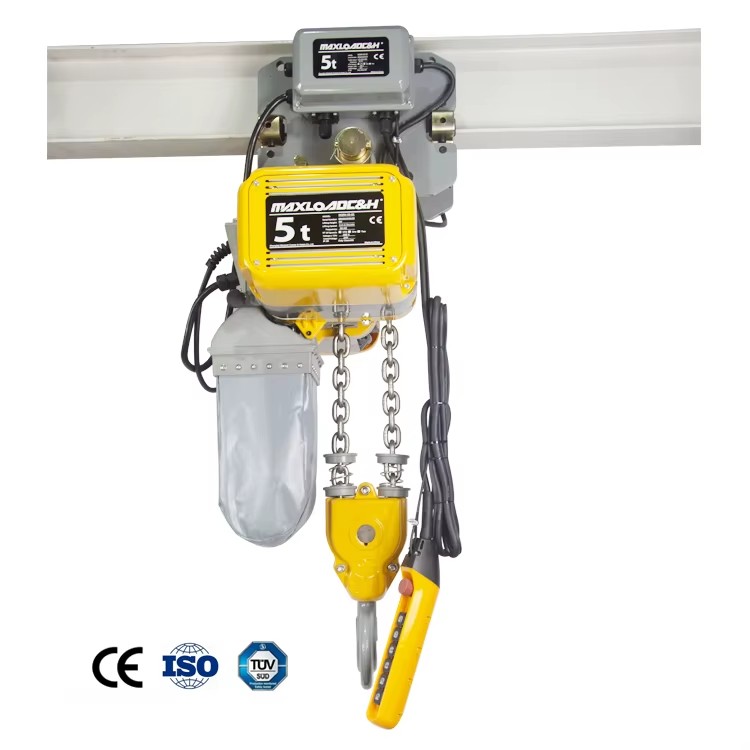
The judgment basis is not "how many tons are lifted per day," but "how many starts per hour." For a rough estimate, a complete cycle usually includes one lifting and one lowering action, plus multiple inching operations that may occur during fine positioning. If the number of cycles per hour exceeds sixty, higher-duty-class models or dual-speed motor configurations should be considered. The significance of dual speed lies not in speed, but in the slow speed gear allowing the operator to precisely control millimeter-level lowering when approaching workpieces or molds, avoiding impact. For precision assembly workstations, the efficiency loss caused by the slow speed gear is far less than the workpiece scrapping cost caused by one collision.
Brake wear is likewise tied to tempo. Under high-frequency start-stop conditions, the consumption rate of brake friction linings is several times that under intermittent conditions. If the specific cycle count cannot be confirmed during selection, it is better to raise the duty class by one level; the extra cost is usually lower than the labor and downtime loss of replacing the brake half a year later.
III. Environmental Particles and Corrosive Media: Protection Rating Is Not a Numbers Game
What is in the air at the workstation directly determines the sealing design of the hoist. In ordinary workshops where only a small amount of dust is suspended, standard protection-rated motors and control boxes are sufficient. But near grinding workstations, polishing workstations, and powder feeding workstations, fine particulate concentration is high and continuous; they will drill into control box contact gaps, adhere to brake friction surfaces, and mix into chain lubricating grease to form abrasive paste. Such environments require attention to two locations: the sealing rating of the control box and the protection method of the chain. IP55 is the bottom line, and cable entry openings of the control box must be locked with waterproof connectors, with no open gaps allowed. Regarding the chain, the links of a chain hoist move relative to each other frequently, and once dust is embedded in the link pockets, it will accelerate wear. At dust workstations, the lubrication cycle should be shortened, or models with chain collection bags should be selected to reduce exposure.
Humidity and corrosion are another selection clue. Food processing workstations often require floor washing, with water mist filling the air; around electroplating or acid pickling workstations, the air contains corrosive acid mist. These two situations threaten the hoist through different paths: moisture mainly intrudes into motor insulation and brake gaps, causing short circuits or brake slipping; acid mist corrodes the chain, hook, and housing coating. The countermeasure for the former is to improve the overall protection rating and ensure the brake cavity has drainage passages; the latter requires stainless steel chains or at least galvanized chains combined with regular anti-corrosion coating. It should be noted that in corrosive environments, galvanized chains of ordinary chain hoists are not suitable as a long-term solution; after the zinc layer is consumed and the substrate is exposed, the corrosion rate will suddenly accelerate.
IV. Red Lines for Special Workstations: Explosion Protection and High Temperature
When flammable gas or dust exists in the workstation environment, the motor commutation sparks, brake friction sparks, or even the arc at the moment control box contacts open of an ordinary electric hoist may all become ignition sources. There is no room for "making do" at such workstations. The flameproof enclosure of an explosion-proof electric hoist encloses parts that may produce sparks inside the housing; even if internal ignition occurs, the flame will not propagate to the external environment. During selection, it is necessary to confirm the hazardous area class and gas group to which the workstation belongs, rather than vaguely requiring "explosion protection." For example, workstations where hydrogen or acetylene exists require Class IIC; ordinary Class IIB cannot cover them. The temperature class depends on the ignition temperature of the flammable substances that may appear in the environment. These parameters should be provided by the safety assessment report to which the workstation belongs and must not be guessed based on experience.
The situation for high-temperature workstations is slightly more complicated. When the ambient temperature exceeds forty degrees, the motor's own heat dissipation capacity decreases, and the winding temperature will be higher under the same load. If the workstation is close to a melting furnace or drying line, thermal radiation will also superimpose on the ambient temperature. At this time, in addition to selecting motors with a higher insulation class, a more practical approach is to calculate the actual duty cycle and, if necessary, reduce the rated load for use. At high temperatures, the lubricating grease on the chain will be lost, and high-temperature-resistant lubricant must be used instead; otherwise, dry grinding of the links will rapidly elongate the pitch.
V. Matching of Operation Method and Workstation Layout
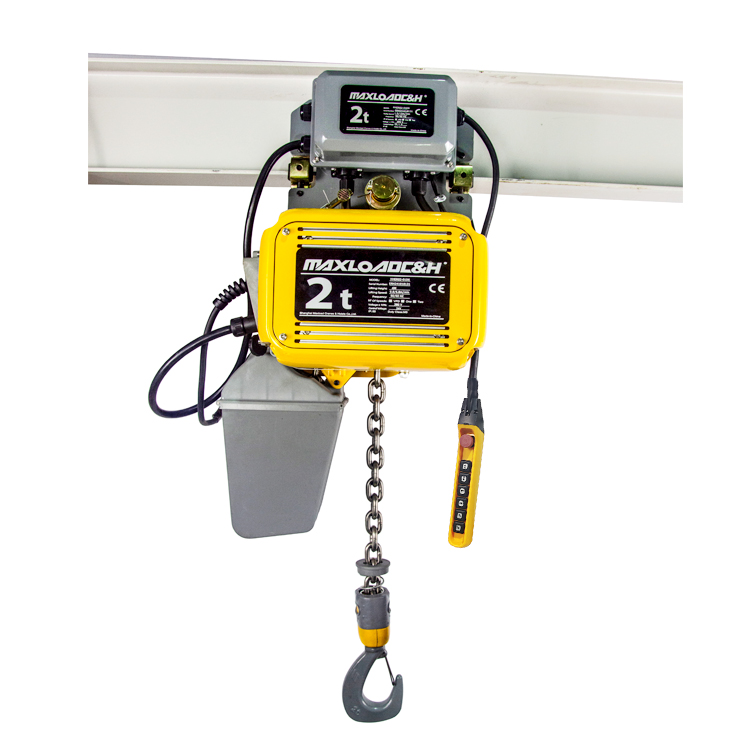
Finally, return to the human-machine interaction level. Whether the workstation has a fixed lifting point or requires movement along a track determines the suspension method of the hoist. A fixed bracket workstation only requires the hoist body plus hook, the simplest structure; a workstation that needs to cover multiple operating points must be equipped with a traveling trolley, and the trolley drive method is further divided into manual push and electric. Manual push trolleys are fully sufficient for workstations with short straight-line distances and low-frequency movement, and they do not add electrical failure points. Electric traveling trolleys are suitable for long tracks or workstations where the operator needs to follow the lifted load, but it should be noted that the duty cycle of trolley motors is usually lower than that of hoist motors; during long-distance frequent back-and-forth movement, the trolley motor may overheat before the hoist motor.
The cable length of the control pendant also deserves attention. When the operating range of the workstation is large, too short a pendant cable will restrict the operator's standing position, while too long a cable is prone to tangling or dragging on the ground and wearing. Generally, it is appropriate that the pendant cable still leaves about half a meter of slack when the operator is at the farthest working position. If multiple hoists operate in crossing fashion at the workstation, distinguishing control frequencies or using coded remote controls should also be considered to avoid mistakenly operating adjacent equipment.
The endpoint of selection is not buying equipment whose parameters meet the standard, but enabling this equipment to operate smoothly at a specific workstation with a predictable maintenance rhythm. By checking clear height, tempo, particles, corrosiveness, explosion-proof requirements, and operation flow one by one, most selection errors can actually be avoided before the contract is signed.
 0086 156 1824 5535
 0086 156 1824 5535