The Underlying Logic and Practical Method for Selecting Electric Hoists
Many factories habitually report only one parameter when purchasing an electric hoist: lifting capacity. A five-ton workpiece gets paired with a five-ton hoist, which seems entirely reasonable. But once the equipment arrives on site, problems surface one by one: in a low-clearance workshop, the hook ends up only a meter or so off the ground after installation, and any workpiece of moderate height simply cannot be lifted; in a dusty workstation, dust accumulates inside the motor within six months and causes cooling failure; on a fast-paced production line, the swaying of a single-speed hoist during start and stop turns workpiece alignment into a repeated struggle.
Selecting an electric hoist is fundamentally not about choosing a device that "can lift how much," but about choosing a solution that can "continuously and stably complete the lifting cycle at a specific workstation." Lifting capacity is only the entry condition. What truly determines equipment lifespan, safety margin, and operational efficiency is the set of implicit constraints that the workstation environment imposes on the equipment. The following sections lay out a practical selection logic, ordered from site survey to parameter lock-in.
Measure the Space Before Discussing Tonnage
The most common cause of rework in workstation selection is a mismatch between installation space and hoist structural form. The clear height of the workshop determines whether the hoist can be installed and, once installed, whether it can be used. The drum structure of a traditional wire-rope electric hoist imposes a minimum body height. In standard workshops with ample ceiling height, this is not an issue. But in old workshop retrofits, under mezzanines, or where piping and conduit have already been routed below the crane rail, vertical space is often compressed to the limit.
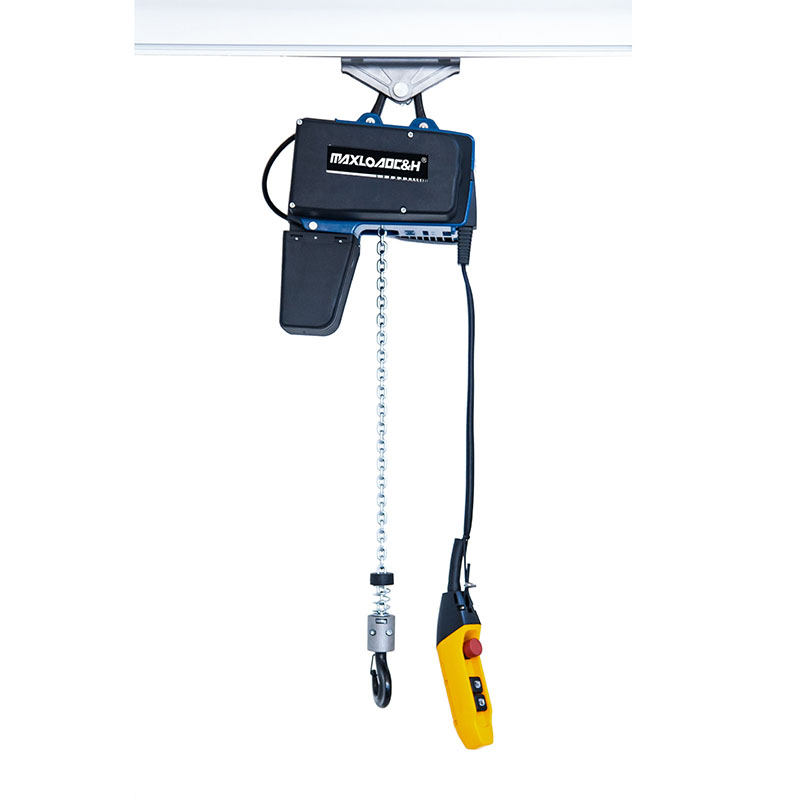
In such cases, chain electric hoists should be prioritized. Their structural compactness comes from the chain-lift principle: there is no long drum occupying horizontal space, and the body height is significantly smaller than that of a wire-rope hoist of the same tonnage. At low-clearance workstations, this difference of a few dozen centimeters directly determines whether the hook can reach the workstation table. Conversely, if the workstation requires a large lifting height—for example, lifting from a pit to an elevated platform—the long-travel capability of a wire-rope hoist is more suitable; under extremely long travel, a chain hoist's stability and chain-length management introduce additional cost.
The judgment sequence should be fixed: first confirm the highest and lowest points the hook must cover, subtract the height of the rigging and the safety margin, and derive the effective lifting height; then use this value to screen structural forms—rather than fixing on a hoist model first and then trying to make the space fit.
Derive Equipment Configuration from Duty Class, Not from Price
Electric hoists typically display lifting capacity on the nameplate, but what really determines whether a hoist can "hold up" at a workstation is its duty class. The M3 to M8 classifications under ISO standards correspond to a comprehensive assessment of daily operating hours, start-stop frequency, and load spectrum. A maintenance workstation that lifts a mold only a few times a day and a production-line workstation that completes a loading/unloading cycle every two minutes should have completely different motor insulation grades, brake wear margins, and gearbox design lives—even if their lifting capacities are identical.
A common misconception on the shop floor is to select for a production-line workstation based on intermittent-duty conditions in order to control procurement cost. In the first few months after installation, no problems appear, but the brake wear and motor temperature rise caused by high-frequency start-stop will manifest collectively within half a year. A reasonable approach is to count the workstation's actual average daily lifting cycles and load conditions. If most lifts are below half the rated load and daily operating time is under two hours, M4 is generally sufficient. If loads frequently approach the rated value and the production pace does not allow the equipment to "rest," the cost increment of selecting one class higher is far lower than the loss from later downtime to replace brakes or motors.
Environmental Protection Is a Hard Constraint, Not an Option
Differences in workstation environment map directly to the protection configuration level of the electric hoist. This item cannot be remedied at low cost through later modification; it must be locked in at the time of purchase.
For conventional indoor dry workshops, the standard protection level suffices. But the following three types of environments require separate scrutiny:
Dusty environments are the most easily underestimated. In grinding workstations, foundry shops, and areas near powder feeding ports, high concentrations of suspended particles in the air mean that the motor's cooling fan of an ordinary hoist will draw dust into the enclosure, where it adheres to windings and bearings. The initial symptom is reduced cooling efficiency; later it may lead to insulation breakdown. Such workstations require attention to the motor's protection rating—IP54 is the baseline—and at higher dust concentrations, designs with independent cooling air ducts should be considered, or a short-time duty regime adopted to avoid continuous dust accumulation.
Humid and corrosive environments are common in electroplating lines, cleaning workstations, and underground shops. Moisture intrusion into the motor or brake can cause brake slippage and winding short circuits. Beyond raising the protection rating, it is necessary to confirm whether the brake has moisture-proof treatment and whether the surface treatment of the chain or wire rope withstands the corrosive medium. If an ordinary chain sits idle for several days in a humid environment, rust may seize the links and impair smooth operation.
High-temperature workstations near melting furnaces, drying lines, or welding positioners may have ambient temperatures exceeding the motor's standard operating range. The insulation class needs to be raised from the conventional F class to H class, and the stability of the brake's friction material at high temperature must also be assessed. If radiant heat is the dominant heat source direction, the orientation of the installation position and the placement of heat shields must likewise be considered at the workstation design stage.
Particular attention should be paid to workstations where flammable or explosive gases or dusts are present: an ordinary electric hoist absolutely must not be used directly. Explosion-proof configuration involves the redesign of the complete set of electrical components—motor, electrical control box, limit switch, and so on—and the explosion-proof area classification must be explicitly stated in the procurement requirements, to be covered by products with the corresponding qualifications.
Match Speed and Control Method to the Operating Rhythm
The choice of lifting speed is likewise determined by workstation tempo. A single-speed hoist has only one rated speed: pressing the button runs it at full speed, and releasing it brakes to a stop. In low-frequency lifting where positioning accuracy is not critical, the simplicity and reliability of a single-speed model is an advantage. But at workstations requiring precise positioning—such as feeding a workpiece into a fixture, aligning bolt holes, or lowering slowly as the load approaches a table—the impact and sway of full-speed operation force the operator to repeatedly jog the control, which both reduces efficiency and accelerates brake wear.
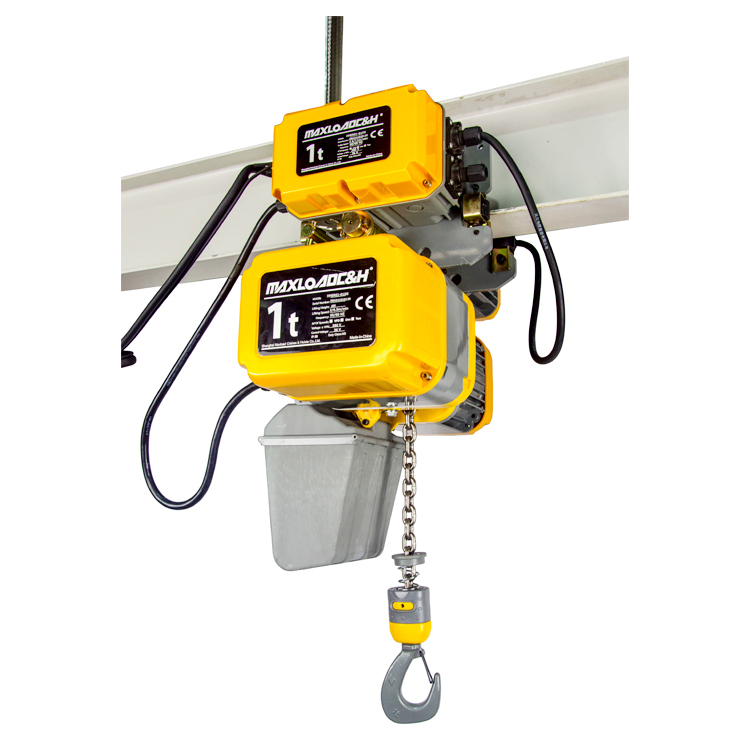
A two-speed or variable-frequency-controlled electric hoist can switch to a low-speed gear when approaching the target position, achieving smooth placement. For production-line loading and unloading workstations, this smoothness translates directly into pace stability. If the hoist is mounted on an electric travel trolley, the trolley travel speed must also be considered: single-speed travel is acceptable for efficiency over long traverses, but at workstations requiring precise stopping, low-speed travel or variable-frequency control is necessary.
There is another easily overlooked dimension of control method: where the operator stands. If the workstation layout requires the operator to be far from the hook, or if the line of sight is blocked by equipment, the operating experience with a wired pendant control deteriorates sharply. In such cases, wireless remote control is not an "advanced feature" but a basic means of ensuring operational safety—the operator can issue movement commands only after clearly seeing the relative position of the hook and the workpiece, rather than relying on experience and blind operation.
Integrate the Above Conditions into a Selection Checklist
After completing the above survey, the communication with the supplier should not consist of just two numbers: "how many tons, how many meters." A selection requirement that can reduce subsequent disputes should contain at least the following items: rated lifting capacity and the distribution of actual daily loads; effective lifting height and installation clearance limits; estimated average daily lifting cycles and single-run duration; workstation ambient temperature range and dust/moisture/corrosive medium conditions; whether explosion-proof or cleanroom special certification is required; speed gear requirements for lifting and travel; and operator position and line-of-sight conditions.
The information these items point to is a specific equipment configuration, not a generic model. The constraint that the workstation environment imposes on an electric hoist is essentially a constraint on equipment reliability under specific temporal and spatial conditions. The professionalism of selection is embodied in translating these constraints into verifiable parameters before the purchase occurs, rather than tracing causes after equipment failure and downtime.
 0086 156 1824 5535
 0086 156 1824 5535