The On-Site Adaptation Logic of Electric Hoist Selection
Many factories habitually look at only two numbers when purchasing electric hoists: how much it lifts and how high it lifts. They take the supplier's catalog, turn to the page for the corresponding tonnage, check a model, and place the order. When the equipment arrives on site and is installed, it works, but after a few months problems begin to surface: either the chain wears abnormally fast, or the motor frequently overheats and shuts down, or operators complain about inaccurate positioning and workpieces constantly being bumped. The root cause of these problems often lies not in the quality of the hoist itself, but in a precondition that was overlooked during selection—the workshop environment.
An electric hoist is not an isolated piece of equipment. It is suspended in a specific space, serves a specific cycle time, and is exposed to specific air. The workshop environment determines which configurations are "nice to have" and which are "necessary." This article does not discuss brands; it sorts out a set of judgment logic for selection based on the environment from the perspective of on-site adaptation.
First, Look at Space: Headroom Determines the Structural Form
When you walk into a workshop, the first thing to look at overhead is not where the track is, but how much vertical distance remains from the bottom of the track to the lowest point the hook needs to reach.
This distance determines whether you should choose a standard hoist or a low-headroom hoist. The drum structure of a standard wire rope electric hoist means that its own height is relatively large. If the factory building has ample height, this is not a problem; large lifting height and smooth operation are its advantages. But in old workshop renovations, or new lines with compact process layouts, the track is often not high above the ground, and relatively tall workpieces or equipment still need to be lifted. If a standard hoist is forced into this situation, the result is that the hook cannot rise to the position it should reach, and operators can only pull at an angle, leading to disordered wire rope spooling and frequent limit switch activation sooner or later.
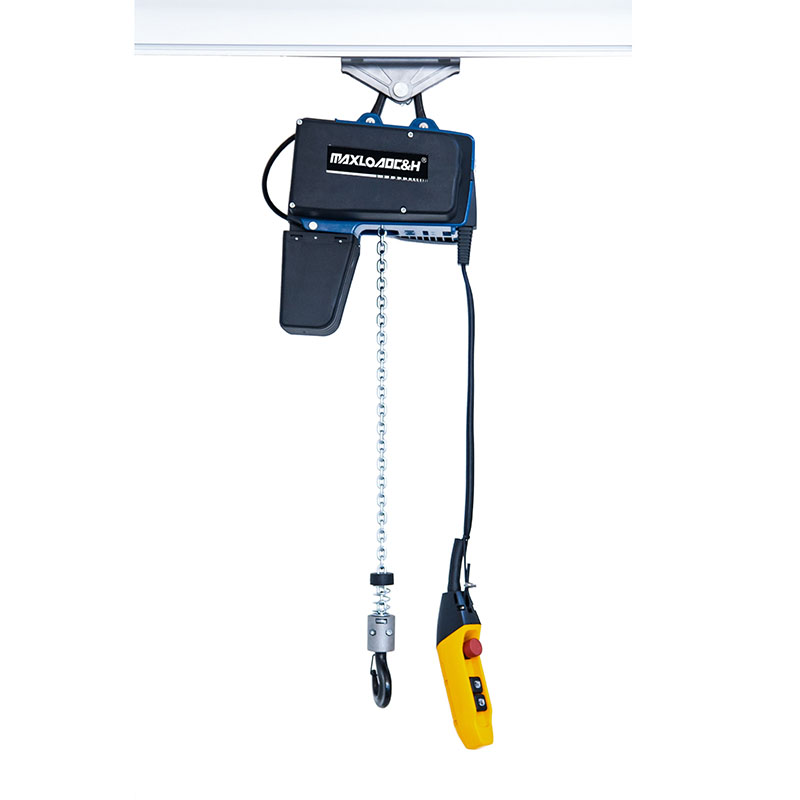
The structural approach of a low-headroom chain hoist is different. It makes the motor and reduction mechanism more compact, and the hook block runs close to the track. Under the same installation conditions, it can gain an additional 200 to 500 mm of lifting margin. Do not underestimate this distance. At workstations with limited headroom, it determines whether the workpiece can safely pass over equipment obstacles or be smoothly placed into fixtures.
The judgment logic is simple: measure the height from the bottom of the track to the highest lifting point of the workpiece, deduct the height of the lifting attachment and the safety margin, and if the remaining value approaches the height limit of a standard hoist, you should switch to a low-headroom solution. This is not an option; it is a hard constraint determined by structure.
Next, Look at Rhythm: The Duty Class Is Not Better When Higher, But It Must Match the Real Load
The duty class is the parameter most easily misunderstood in selection. Some people think choosing one class higher is safer, while others choose the lowest class directly to save budget. Both approaches deviate from the real needs of the workstation environment.
The essence of the duty class is to describe how hard this hoist is actually used at its workstation. M3 corresponds to intermittent scenarios with cumulative operation of no more than two hours per day and small load fluctuations; M4 corresponds to routine workshop handling of three to four hours per day; M5 must handle high-frequency operations on assembly lines of four to eight hours per day with relatively large load fluctuations. If a hoist is installed at a fixed workstation beside an assembly line and must lift a workpiece every three minutes, with two shifts per day, choosing an M3 machine is tantamount to making it operate under long-term overload. Motor temperature rise will quickly approach the limit, and brake wear will far exceed design expectations.
Conversely, if the workstation only occasionally lifts molds or repair parts and operates only a few times a day, choosing M5 or even M6 is paying for unnecessary redundancy. Hoists with higher duty classes are higher in structural member thickness, motor insulation grade, and brake specifications, so procurement costs rise, while they do not show additional advantages at low-frequency workstations.
A practical judgment method is: count the actual number of lifts at this workstation within one shift, and observe the proportion of lifts close to the rated load. If the number of lifts per day exceeds one hundred and most loads are close to the rated value, M5 is the bottom line; if workpieces are only occasionally lifted on an assembly line, M4 is sufficient. Only when the duty class is selected correctly can the balance point between equipment life and failure rate be found.
Environmental Media Determine Protection Configuration: Do Not Put an Ordinary Hoist into a Chemical Plant
This is the place where you should least cut costs in selection. The motor, electrical box, and chain or wire rope of an ordinary electric hoist are designed for dry, clean indoor air. Once corrosive gases, high-concentration dust, salt spray, or flammable and explosive media exist in the workstation environment, the failure of an ordinary hoist is no longer a question of "whether it works well" but a question of "whether it is safe."
In electroplating workshops, beside pickling lines, or in coastal factory buildings, acid-base particles or salt spray suspended in the air will continuously corrode the chain surface and the coating of the motor housing. At first, it is only a dull appearance; after a few months, the chain pitch begins to increase, and abnormal noise during operation becomes more and more obvious. In this case, models with anti-corrosion treatment are required—light corrosive environments can be handled with anti-corrosion coatings and galvanized chains, while severe corrosion requires stainless steel chains or higher-grade surface treatment.
The same applies to high-dust environments. In cement plants, flour mills, and mine crushing workshops, the concentration of suspended particles in the air is high. The motor cooling fan of an ordinary hoist will draw these dust particles into the housing and deposit them on windings and bearings. Reduced heat dissipation leads to motor overheating, while dust accumulation in brake gaps makes braking response sluggish. The key to a dust-proof hoist lies in the sealing grade of the motor and electrical box, as well as the filtration design of the cooling air duct, preventing dust from entering rather than merely "allowing dust to exist."
As for flammable and explosive workstations, the selection logic switches completely. In chemical workshops, paint booths, grain silos, and similar places, the hoist motor, contactors, and even static accumulation may become ignition sources. The motor junction box, control box, and brake of an explosion-proof hoist are all treated with flameproof or intrinsically safe protection, and the surface temperature is limited below the ignition temperature of the ambient gas. There is no room for "good enough" in this configuration—the environmental classification determines the explosion-proof grade, and the explosion-proof grade determines which models can enter this workstation. This is a boundary drawn jointly by regulations and physical laws.
Operation Mode and Workstation Traffic Flow Determine Control Configuration and Speed Selection
The same hoist, hung at different workstations, is used by operators in completely different ways. This directly affects two configurations: control mode and speed range.
If the hoist is installed at a fixed suspension point or on a monorail trolley and the operator stands on the ground pulling a pendant control, then whether the control cable length and button layout are convenient matters more than any fancy function. If the hoist needs to travel a long distance along an I-beam track, the advantages of wireless remote control become prominent—the operator can stand next to the workpiece, avoid blind spots, and fine-tune the position while observing the lifting status. The dragging feel and cable wear of a wired pendant control on long-distance tracks are frequent sources of on-site complaints.
The same applies to speed selection. Single-speed hoists are simple in structure and low in failure rate, suitable for simple cycles of "lift, move, lower." But at precision assembly workstations, where workpieces need to approach fixtures slowly, or where fragile or easily scratched surface parts are being lifted, the jerkiness of single-speed lifting is a disaster. Two-speed hoists provide fast and slow gears; slow speed is used for alignment and fine adjustment, while fast speed is used for empty hook return and long-distance lifting, balancing efficiency and precision. If the workstation cycle time requires higher performance, variable-frequency control can achieve stepless speed regulation, with softer start and stop, but the cost rises accordingly. The judgment criterion is not "which is more advanced," but whether the workstation's requirement for positioning accuracy is worth paying extra for smoothness.
Leave a Tonnage Margin, But Do Not Enlarge Blindly
There are two common extremes in tonnage selection: one is to select strictly according to the maximum workpiece weight, ignoring the self-weight of the lifting attachment and the dynamic load impact at the moment of lifting; the other is to "move up two classes," choosing a five-ton hoist for a two-ton workpiece, thinking it is foolproof.
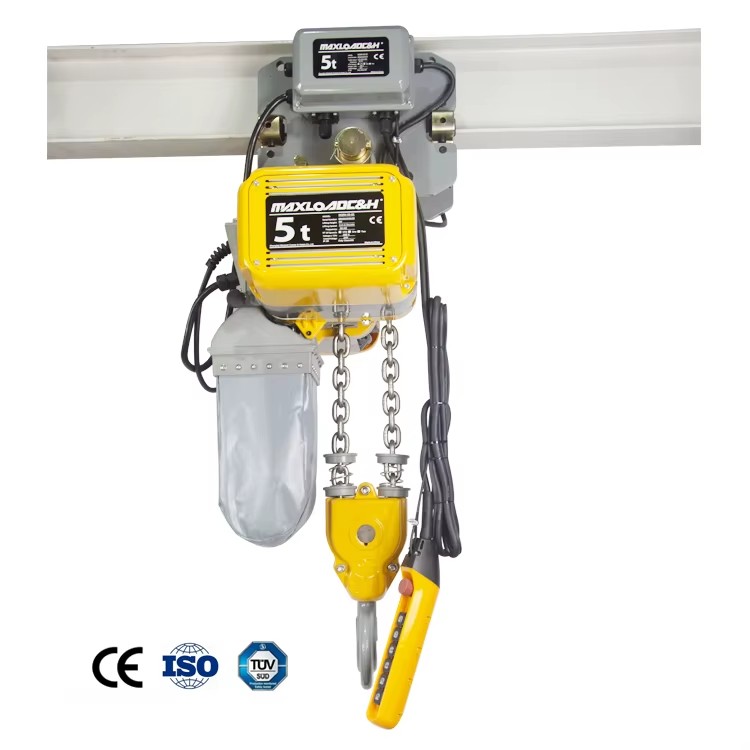
The risk of the former lies in overload. The impact coefficient at the moment of lifting, the weight of the lifting attachment, and the slight elongation of the chain or wire rope after long-term use will all cause the actual load to exceed the rated value. Under conventional working conditions, matching the rated lifting capacity at 1.25 times the maximum workpiece weight is a reasonable starting point; if the workstation involves frequent lifting, vibration, or outdoor factors, the margin should be relaxed to 1.5 times.
The cost of the latter is a double waste of space and cost. The body size, hook block weight, and track load-bearing requirements of a large-tonnage hoist all increase significantly. At a workstation where headroom is already tight, choosing a hoist two classes larger "for safety" may instead consume the lifting height. The principle of tonnage matching is: the rated lifting capacity only needs to cover "workpiece + lifting attachment + dynamic load margin," without paying for working conditions that do not exist.
Conclusion
The selection of an electric hoist is essentially the process of translating the physical conditions, operation rhythm, and environmental characteristics of the workstation into equipment parameters. Headroom determines the structural form, load frequency determines the duty class, air composition determines the protection grade, operation traffic flow determines the control mode, and workpiece weight determines the tonnage margin. These five dimensions are not independent and often constrain one another—low headroom may mean a chain structure, while the duty class of chain hoists is usually mainly M4/M5. If this workstation happens to involve high-frequency heavy-duty operation, it is necessary to make trade-offs between structural form and duty class rather than expecting to find a perfect model that "has everything."
Take these dimensions and measure them on site: measure the headroom, count the number of lifts, see what is floating in the air, and ask the operators which step bothers them most. The answers are more reliable than the parameter tables in any catalog.
 0086 156 1824 5535
 0086 156 1824 5535