Five Hard Constraints for Selecting an Electric Hoist
When selecting an electric hoist, many people are accustomed to first flipping through catalogs to check tonnage, then ticking off parameters according to lifting height, and finally asking for a quote. This process seems efficient, but it easily exposes problems in the third month after production starts: either the motor is too hot to touch, or the hook sways so much that it cannot align with the pin hole, or after half a year the chain has elongated and become scrapped. The root cause is not the quality of the hoist itself, but that the workstation environment was treated as background information rather than a constraint during selection.
The selection logic for electric hoists should be reversed: first clearly identify what hard boundaries the workstation sets for the equipment, and then find matching specifications within those boundaries. The following breaks down, from five dimensions, the substantive impact of the workstation environment on selection.
Spatial Clearance: Determines the Physical Form of the Hoist
The vertical space of a workstation often eliminates a batch of options before the layout does. The drum structure of conventional wire rope electric hoists determines that their body height is relatively large. If there are ventilation ducts, fire sprinklers, or existing steel structure beams at the top of the factory building, the actual available clearance may be more than half a meter less than the drawing elevation. In such cases, the compact body advantage of chain hoists is obvious. Their drumless design makes the dead zone distance from the hook to the upper part shorter, allowing effective lifting travel to be gained in low spaces.
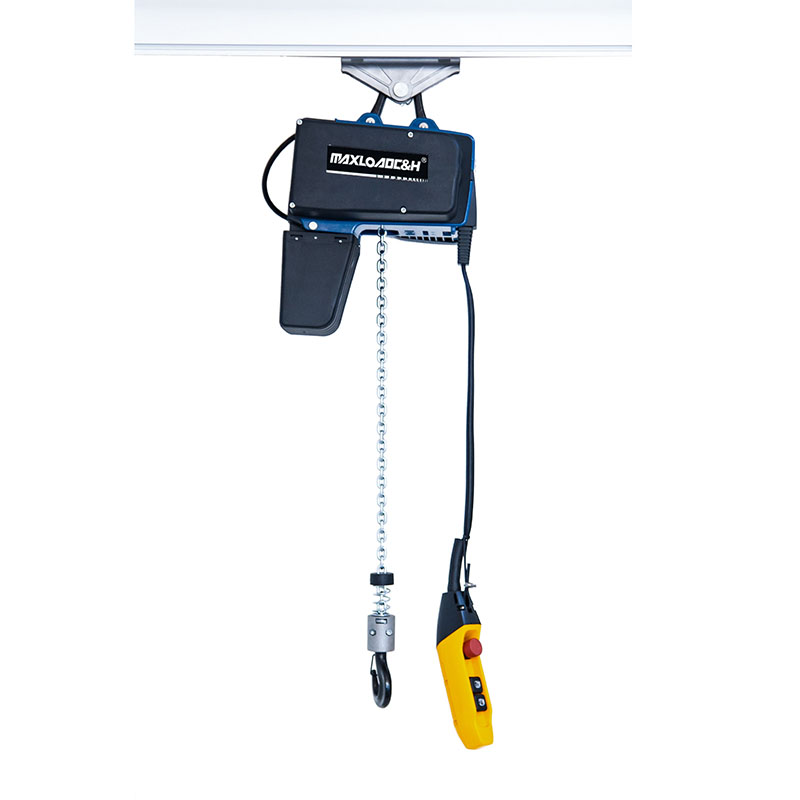
However, clearance constraints are not limited to the vertical direction. If the workstation is located on an existing monorail or single-girder crane, it is also necessary to confirm whether the profile dimensions of the hoist trolley match the rail flange. Curved workstations require even more attention: some trolley designs are only suitable for straight sections, and forcing them onto curved rails will cause wheel flange wear, with rim wear appearing within a few months. During selection, the rail direction, curve radius, and trolley type should be checked together, rather than dealing with interference issues after the equipment arrives.
Work Cycle: Determines the Motor's Duty Rating
Whether the workstation is for intermittent lifting or assembly-line paced operation places completely different requirements on the motor. Occasional loading and unloading in a warehouse or parts replacement at a maintenance station are typical light-duty or medium-duty working conditions. The motor's energization rate is low, heat generation is not the main contradiction, and a single-speed model is sufficient, with fewer failure points and simpler maintenance.
But if the workstation is on an assembly line and completes a full cycle of picking, lifting, positioning, and lowering every three minutes, the heat accumulated by the motor during repeated starts is the key to selection. At this time, what needs attention is not only tonnage, but also the duty cycle rate and allowable starts per hour corresponding to the working class. A hoist designed according to the M3 class and operated under an M5 pace will cause the motor winding temperature to continue rising, and insulation aging will be much faster than expected. Such workstations must also consider dual-speed or variable-frequency control: the slow-speed gear is used for the last few centimeters near the workpiece to avoid the suspended load hitting fixtures or conveyor belts; the fast-speed gear is used for empty hook return to shorten auxiliary time. A single-speed machine in such workstations will either suffer efficiency loss or lose precision control.
Material Positioning Accuracy: Determines Control Method and Braking Match
Whether the lifted object is a rough steel ingot or a precision mold insert places completely different requirements on the hoist's dynamic response. The wire rope or chain itself has elasticity, and together with the lag in brake action, a single-speed hoist will produce an obvious "nodding" phenomenon in which the hook first drops and then rebounds during inching operation. For assembly workstations that need to insert a pin shaft into a hole, this swaying can double the positioning time.
The value of variable-frequency control truly emerges here: through ramped start and stop, the suspended load can remain stable at the moment of leaving the ground and before positioning, and the operator can use inching to control the load within millimeter-level travel. However, note that the inverter is not plug-and-play. Its parameters need to be tuned according to the actual load and workstation habits; otherwise, the soft-start characteristic may instead make workers accustomed to traditional operation feel that it is "slow to respond." If a variable-frequency solution is determined during selection, the supplier should be required to complete parameter adaptation based on the actual lifting load during commissioning, rather than merely providing factory default values.
Environmental Medium: Determines the Baseline for Protection and Materials
What is suspended in the air at the workstation and what the temperature is directly define the protection baseline for the hoist. In ordinary workshop dust environments, the motor's built-in fan will continuously inhale particulate matter, which adheres to windings and bearings and accelerates wear. Dusty workstations should give priority to models with a protection rating of no less than IP55, and confirm whether the brake gap is convenient for regular cleaning.
The problem in humid or open-air workstations is not rain, but condensation. The temperature difference between day and night causes condensation inside the motor; insulation resistance decreases, and it trips as soon as power is applied. Such environments require motors with anti-condensation heating strips or higher protection ratings. As for chemical workshops, paint booths, or dust-explosive environments, the motor commutation sparks and brake friction surfaces of ordinary hoists are ignition sources, so models with the corresponding explosion-proof rating and temperature class must be selected, and the installation and wiring methods must also comply with regulations. There is no room for compromise at this step: either the environment is confirmed to be qualified, or the equipment is modified. There is no intermediate state of "it can work well enough."
Operator Position: Determines the Location and Form of Control Devices
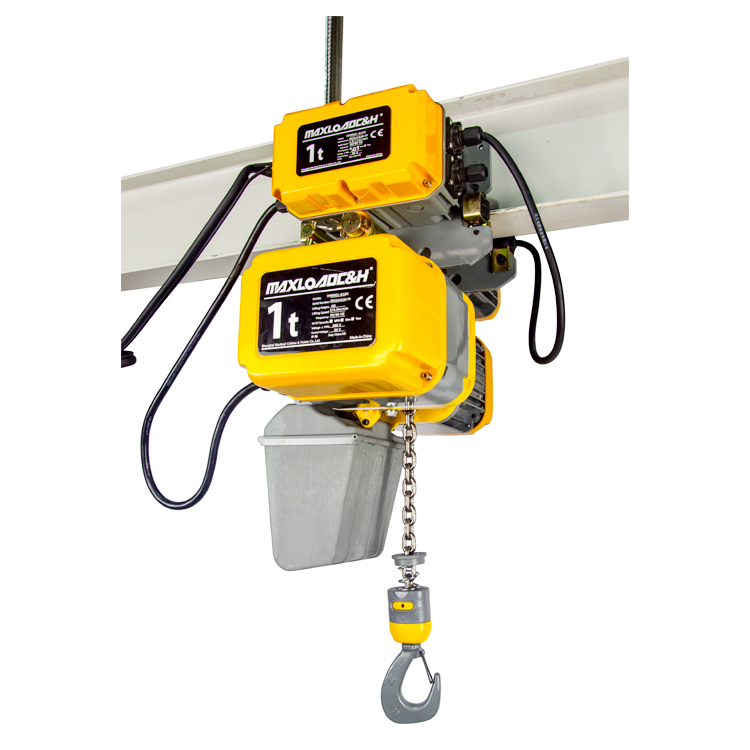
This point is often overlooked, yet it directly affects workstation efficiency and safety. Hoist control devices are generally of two types: pendant and remote control. Pendants are wired, with direct response and no signal delay, but the operator must follow the suspended load. In narrow workstations or where there are obstacles on the ground, this instead increases the risk of tripping. Wireless remote control allows the operator to stand in the position with the best view, especially suitable for long-span lifting or scenarios where the suspended load needs to avoid equipment.
But remote control is not a panacea. In workstations requiring fine positioning, it is common to need to operate the remote with one hand while steadying the load with the other. Whether the remote's grip shape and button layout allow the thumb to switch quickly between lifting and travel can only be known after actually holding it. Another hidden factor is remote control management: whether it is fixed in a designated position at the workstation or kept by a dedicated person directly affects shift handover efficiency. If the workstation operates in multiple shifts, the storage method and handover rules for the controller should be determined during selection; otherwise, even the best equipment will stop operating because "the remote control cannot be found."
Final Words
Electric hoist selection errors are rarely due to miscalculating tonnage, but more often due to treating the workstation environment as a condition that can be "overcome." If clearance is insufficient, lift at an angle; if the pace is too fast, replace the motor; if there is too much dust, clean it frequently—the cost of these on-site remedial measures is often not included at the time of procurement. Conversely, if space, cycle, precision, medium, and operating method are screened item by item as selection conditions during the selection stage, the remaining options may be few, but each one can run steadily at the workstation until the next major overhaul cycle. The relationship between equipment and workstation is never "install it and it can be used," but rather "after installation, people do not need to worry about it."
 0086 156 1824 5535
 0086 156 1824 5535