The Cost of Choosing the Wrong Electric Hoist Often Only Surfaces After Installation
When many people choose an electric hoist, they are used to looking at tonnage and price first and putting environmental conditions last. This approach may get by without problems in a standard workshop, but once the workstation has humidity, dust, corrosive media, explosion-proof requirements, or headroom constraints, the failure rate after the equipment is put into use rises sharply. What is more troublesome is that electric hoists are fixed-installation equipment. Once it is found that the selection does not match, the cost of dismantling and modifying the track and replacing the model is far higher than the price difference at the procurement stage.
The impact of the workstation environment on selection is not as simple as "pay more and buy a higher configuration." Different environments correspond to different protection logic, material systems, and structural forms. Choosing the wrong direction is more dangerous than choosing a lower configuration. Below, the selection judgment basis for electric hoists is broken down according to several of the most common types of constraint conditions in workstation environments.
Settle the structural form first, then discuss the rest
The space at the top of the workstation is the hardest constraint. The installation method of the electric hoist directly determines the effective lifting height, and if the effective lifting height is insufficient, all subsequent parameters become meaningless.
For workstations where the factory building height is sufficient and the top structure allows the laying of tracks, the wire rope electric hoist is the conventional choice. Its lifting height range is large, operation is stable, and it is suitable for long-distance, large-travel lifting operations. But if it is an old factory renovation, a workstation below a mezzanine, or if there are already ventilation ducts, cable trays, and other obstacles at the top, and the vertical space is compressed to the extreme, the low-headroom advantage of the chain electric hoist becomes apparent. The chain model has no drum structure, and its body thickness is significantly smaller than that of the wire rope model. Under the same installation conditions, it can provide several tens of centimeters more effective lifting travel.
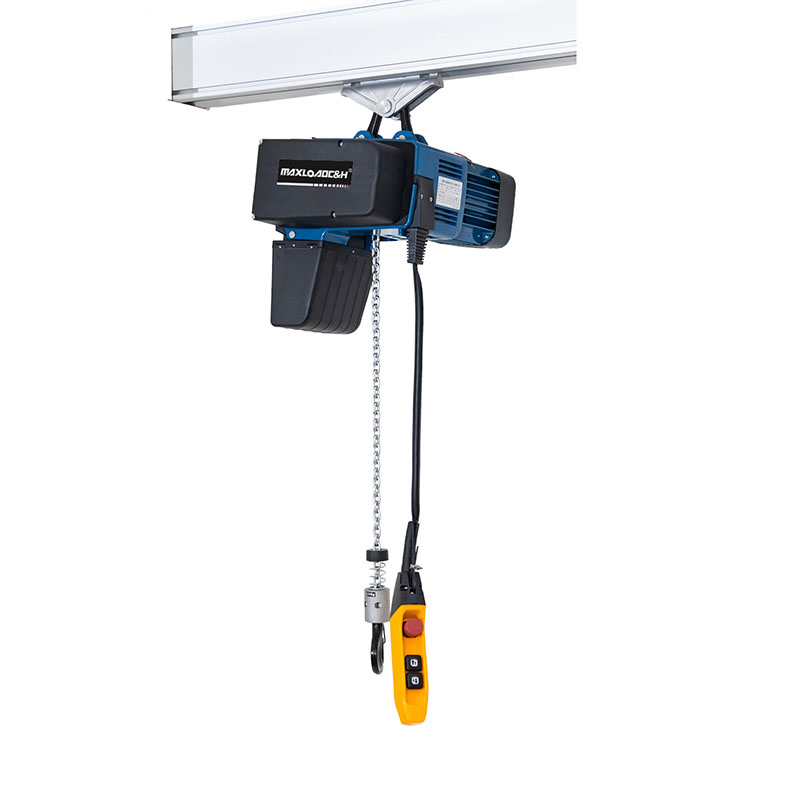
Here is a detail that is easily overlooked: workstation headroom must take into account not only the height occupied by the hoist body, but also the suspension length of the hook assembly and rigging. The actual occupied space at the moment of lifting is often ten to twenty centimeters more than the static dimensions. If the selection is made right at the limit according to static dimensions, it is very likely after installation that the hook cannot reach the workpiece.
Operating frequency determines the speed configuration; where is the boundary between single-speed and dual-speed
The workstation cycle time is the core indicator for distinguishing single-speed and dual-speed models. For occasional lifting in warehouses and intermittent use at maintenance workstations, single-speed models are fully sufficient, with simple structure, fewer failure points, and low maintenance costs. But the situation is different for assembly line workstations, high-frequency loading and unloading workstations, or assembly workstations that require precise positioning.
The impact of a single-speed hoist at startup and stop is relatively obvious, and the hook and workpiece will sway. For workstations that need to accurately place workpieces into fixtures, pass through holes, or move within narrow spaces, this sway directly reduces efficiency and may even cause workpiece collisions. Dual-speed models provide a slow-speed gear with stable start and stop, and noticeably better micro-movement during inching operation. The judgment during selection can be as follows: if the workstation operator needs to repeatedly "tap once, stop once" to align the position, dual-speed is a necessary configuration, not an option.
Environmental media determine protection level and materials; there is no compromise solution
This is the most problematic link. The design baseline of ordinary electric hoists is an indoor, dry environment without corrosive media. Once the workstation deviates from this premise, the protection configuration must change accordingly, and there is no room for "making do."
For humid and high-humidity workstations, such as inside ship cabins, pulp workshops, and under open-air sheds, the core threats are water vapor penetration and rusting of metal parts. The protection level must be at least IP65; key seams need sealing treatment, and chains or wire ropes should preferably use stainless steel material or surfaces treated with hardening and anti-corrosion treatment. If the workstation also has salt spray, such as seaside factories or seafood processing areas, carbon steel parts will begin to rust from the edges even if painted, and the material grade of load-bearing components needs to be correspondingly improved.
For the selection of dust workstations, the nature of the dust must be distinguished. For inert dust such as cement and mining dust, the focus is to prevent dust from entering the motor and gearbox and causing jamming or short circuits. A protection level of IP54 or above and a sealed structure in place are sufficient. But combustible dust such as flour, starch, wood powder, and metal powder is completely different in nature. After suspended dust reaches a certain concentration, it will deflagrate when encountering sparks. Sparks from the brushes of ordinary motors and contact arcs from electrical switches are enough to become ignition sources. Such workstations must use dust explosion-proof models, with explosion-proof markings corresponding to the dust category, and the protection level must be able to prevent dust from entering the interior of the enclosure. Agricultural product processing workstations are often misjudged as "not dangerous," but in fact the dust explosion risk of wheat flour and corn flour belongs to typical categories among industrial dusts.
For workstations with corrosive media, such as beside electroplating tanks, in pickling workshops, and in fertilizer production areas, acid and alkali gases or droplets will continuously corrode the hoist housing, chain, and hook. Mild corrosive environments can be handled with anti-corrosion coatings, but for workstations with strong acids and alkalis or long-term exposure to corrosive media, once the coating is damaged, it loses its protection. Stainless steel material or a fully enclosed anti-corrosion structure is the more reliable choice.
Explosion-proof selection should not only consider "whether explosion protection is needed," but also "what explosion is being protected against"
Gas explosion protection and dust explosion protection are two different technical paths, and explosion-proof ratings cannot be used interchangeably. Gas explosion protection targets flammable gases or vapors, such as chemical workshops, paint warehouses, and gas areas. Explosion-proof markings usually start with Ex d and are classified by gas category and temperature group. Dust explosion protection targets suspended dust environments, and the explosion-proof markings and enclosure sealing requirements are clearly different from gas explosion protection.
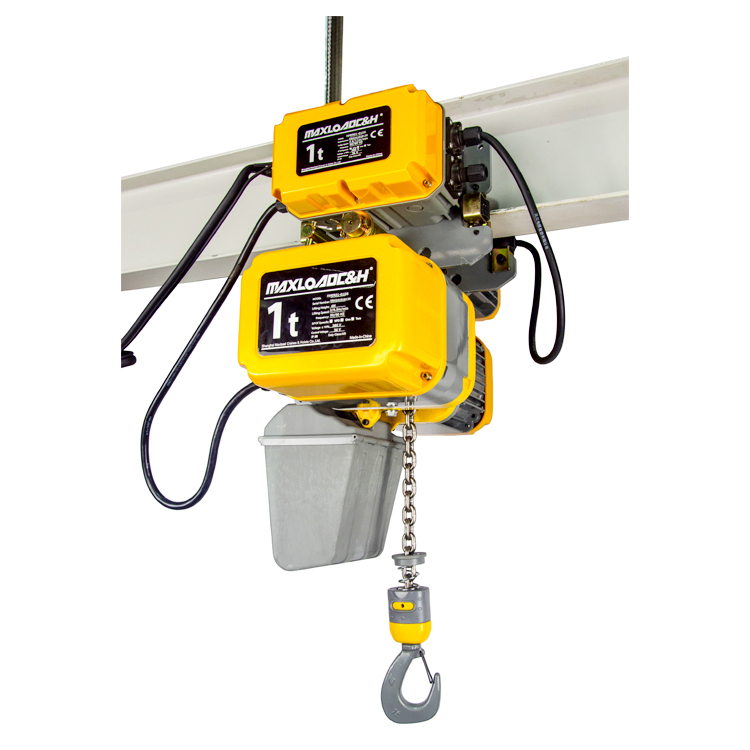
There is a common misjudgment during selection: using a gas explosion-proof model in a dust workstation. The protection level of a gas explosion-proof hoist may not cover the intrusion requirements of high-concentration dust, and the enclosure sealing design of a dust explosion-proof model may not meet the flameproof requirements of a gas environment. Whatever type of explosive medium exists at the workstation, the corresponding explosion-proof type should be selected. They cannot be mixed just because "both are explosion-proof." In addition, an explosion-proof hoist is not equal to waterproof. Humid explosion-proof workstations still require additional rain and moisture protection measures.
Leave margin in tonnage, but do not treat margin as omnipotent
The bottom line for tonnage selection is the maximum lifting weight plus the dead weight of the rigging, then multiplied by a safety factor. For conventional intermittent operation workstations, a 1.25x margin is the basic line; for workstations with frequent operation and obvious impact at the moment of lifting, the margin should be raised to 1.5x. The dynamic load coefficient at the moment of lifting is often underestimated—the actual load at the moment the workpiece leaves the ground may be considerably higher than the static weight.
But margin cannot replace the correct model selection. A 2-ton ordinary hoist used in a humid workstation will not become durable just because a larger tonnage was purchased; a hoist without explosion-proof certification used in a dust workstation will not eliminate the ignition risk just because the safety factor was set at 1.5x. Tonnage is a basic parameter, and environmental adaptability is the key to determining whether the equipment can survive to its design life at this workstation.
Confirm one thing before installation
In the selection chain of electric hoists, the workstation environment is the starting point, not a supplementary item. First measure the headroom to determine the structure, then look at the cycle time to determine the speed, then go through the environmental media to screen protection and materials, separately confirm the explosion-proof type for explosion-proof workstations, and finally leave margin according to the actual load. Following this order, the selected model may not be the most expensive, but it is very likely the one with the fewest failures and shortest downtime at this workstation.
If the on-site conditions of the workstation are complex and you are unsure about the boundaries of environmental classification, a pragmatic approach is to provide raw data such as media samples, dust concentration, and ambient temperature and humidity range to the selection personnel, rather than just saying "the workshop is a bit humid" or "a bit dusty." Vague descriptions correspond to vague configurations, and in the end it is the actual user of the equipment who suffers the loss.
 0086 156 1824 5535
 0086 156 1824 5535